Introduction: Cold Drinks Should Be Available Where the Gathering Happens
Nothing kills a good patio night faster than the “warm beer shuffle”—guests piling into your kitchen, dripping pool water across the floor, digging past leftovers, and leaving the fridge door open like it’s a museum exhibit.
Outdoor spaces aren’t just “a grill and a chair” anymore. They’re full outdoor kitchens, pool bars, hotel terraces, rooftop lounges, and event patios where the drinks are part of the experience. And an outdoor beverage refrigerator has to do more than hold cans—it has to keep its temperature while fighting heat, humidity, splash risk, door slams, and the chaos of real service. Buy it like a grown-up: define the job, confirm it’s actually outdoor-rated, plan the install, and pick a supplier you won’t regret when it’s 96°F and your bartender is glaring at you.

Define What Your Outdoor Beverage Refrigerator Needs to Do
Identify the Outdoor Entertainment Environment
Start by admitting where this fridge is going to live. A covered residential patio in Ohio is not the same beast as a rooftop bar in Phoenix or a pool deck in coastal Florida.
Residential and lifestyle installs usually mean: shorter bursts of use, fewer restocks, and more “I want it to look nice next to my grill.” Think backyard kitchens, covered patios, pool houses, barbecue corners, and home bars—plus the big question: seasonal use or year-round exposure?
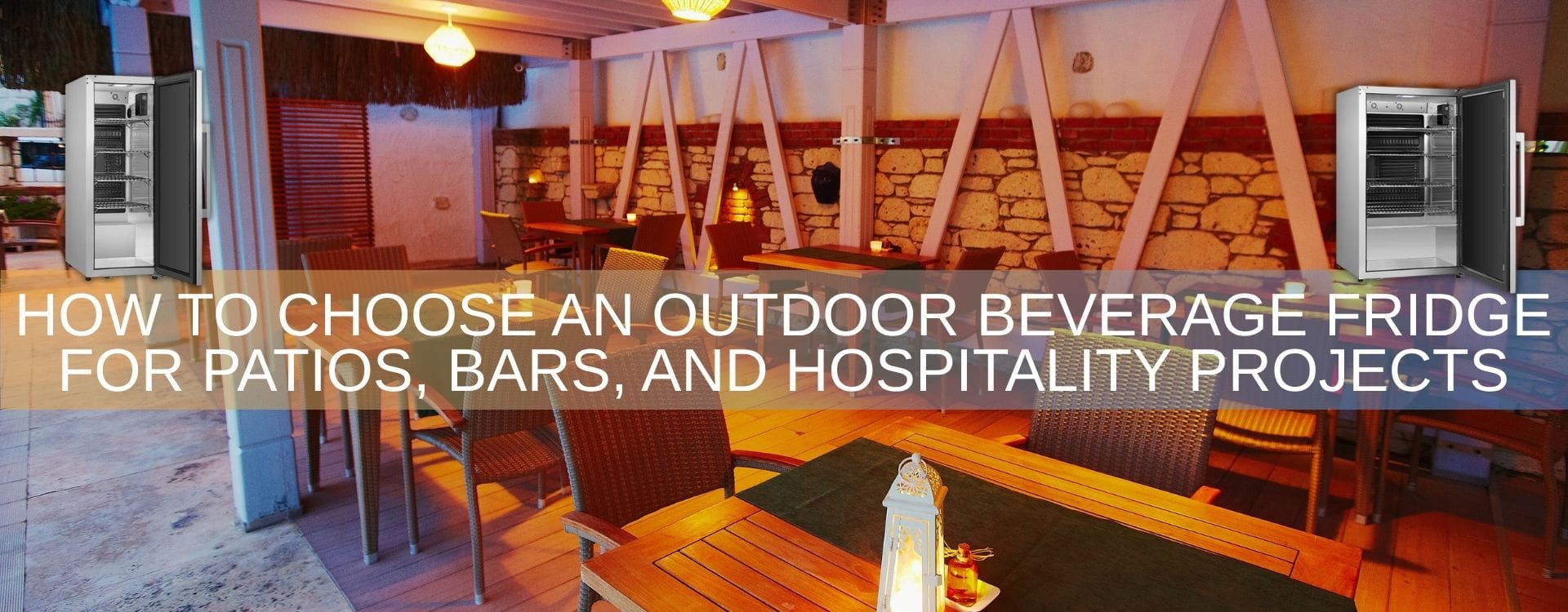
Commercial and hospitality use is a different planet: restaurant terraces, rooftop bars, hotels, resorts, clubs, and event venues. Translation: constant openings, warm product getting loaded mid-service, and people who will yank the handle like they’re starting a lawnmower.
Then measure exposure honestly: fully covered vs semi-covered vs open-air. Direct sun, wind-driven rain, humidity, salt air, dust, and whatever your local summer temperatures do when the patio is packed. Miss this step and you’ll “save money” right up until you’re buying the fridge twice.
Match the Refrigerator to the Beverage Menu
Make the beverage list first. Not later.
Cans are easy. Beer bottles need shelf spacing that doesn’t turn loading into a game of Tetris. Mixers, bottled water, and tall energy drinks all have their own annoying dimensions. And if you’re planning to stash garnishes or service items in there, make sure the design and shelf layout actually allow it—some units are beverage-only in the way they circulate air and handle condensation.
Temperature expectations matter more than people want to admit. General “cold drinks” storage is one thing. Keeping beer crisp while you’re slinging soft drinks and constantly opening the door is another. Turnover matters too: light household use vs continuous service, recovery time after restocking warm product, and whether the box can settle back to temp after a dozen openings in ten minutes.
Calculate Capacity Around Peak Demand
Buy for the busiest gathering, not a random Tuesday.
Do a rough peak math pass: guest count × average drinks per person × time window. Then add a buffer for the “oh cool, you invited the neighbors” effect. The advertised “holds 120 cans” number is marketing—what matters is shelf geometry, usable depth, and whether shelves can move or come out when you inevitably show up with oddball bottles.
Also think about restocking workflow. Where’s the backup inventory—inside the building, down a hallway, up a service elevator? If staff (or you) have to sprint back and forth, the outdoor fridge becomes a choke point. Leave space to load, organize, and rotate product without unloading half the unit onto someone’s lap.

Confirm That the Beverage Fridge Is Truly Outdoor Rated
Check Outdoor-Rated Construction and Protection
“Stainless steel” is not a magic spell. Plenty of shiny fridges are still indoor-only.
Read the certification language and—more importantly—the warranty. Some brands make it blunt: their outdoor warranty applies only to products specifically designed for outdoor use, and you don’t get to “declare” an indoor unit outdoor just because it’s under an awning.
Look at the cabinet materials, hinges, fasteners, and door frame. Outdoor-rated units should be built to tolerate moisture, frequent cleaning, and the kind of corrosion you get from humidity and airborne junk. If you’re near salt air (or a saltwater pool), stainless grade suddenly matters: 316 is generally more resistant to chloride/salt corrosion than 304.
And don’t skip the unsexy stuff: electrical protection and moisture handling. Outdoor humidity is a bully. If the unit isn’t designed for it, you’ll get weird failures that look “random” and are anything but.
Evaluate Cooling Performance in Real Outdoor Conditions
Ask one question that cuts through the brochure nonsense: What ambient temperature range is it designed to run in?
Real examples from mainstream outdoor-rated undercounter units commonly top out around 100°F ambient. U-Line’s outdoor-capable units call out operation in a 50°F to 100°F range in their documentation. Perlick’s residential design guide lists outdoor operating ranges like 45°F to 100°F for certain models. That’s not a defect—it’s just physics plus compressor sizing plus how much heat the condenser can dump.
Then look at recovery behavior: how fast it pulls back down after door openings, and how it handles warm restocks. Also check airflow requirements: internal circulation (so you don’t get warm top-shelf drinks) and condenser ventilation (so the unit doesn’t cook itself inside tight cabinetry). Built-in and freestanding models have different clearance needs—ignore them and you’re basically insulating the condenser, which is impressively self-destructive.
Compare Long-Term Reliability, Not Just Purchase Price
Outdoor use is expensive on appliances. Heat shortens component life. Humidity accelerates corrosion. Constant openings punish gaskets and hinges.
So look past the sticker price and think total cost of ownership: energy use in hot conditions, maintenance frequency, parts availability, coil-cleaning access, and how painful it is to service the refrigeration system once the unit is locked into stone and steel.
Warranty and support aren’t “nice to have,” especially for commercial buyers. You want clear compressor/electronics coverage, real documentation, and a support process that doesn’t collapse the minute you mention “installed outdoors.”
Match the Outdoor Beverage Cooler to the Installation
Choose Between Built-In and Freestanding Models
Built-in outdoor beverage fridges are made to live inside outdoor kitchen runs—clean lines, coordinated look with grills and cabinets, and a more “intentional” finish. But they demand correct ventilation and clearances, or they’ll struggle.
Freestanding units give you more freedom: move it for seasonal layouts, tuck it near the bar during a party, shift it under deeper cover when storms roll in. The tradeoff is you need to protect airflow all the way around, and you’ll see the sides and top—so choose a cabinet finish that doesn’t look like a cheap office breakroom fridge that wandered outdoors.
Either way, confirm physical dimensions: opening width/depth/height, door swing direction, handle clearance, and access space for power and future servicing.
Prepare the Outdoor Site Before Installation
Power needs to be outdoor-appropriate and compliant with local code. No, not an extension cord. Not a “temporary” plug that becomes permanent for five years.
Keep the unit away from grills and hot cooking zones. Also try to avoid direct afternoon sun—shade matters because you’re basically asking the fridge to pump heat out while someone is dumping more heat onto it from the outside. And manage water: don’t install where rain or washdown leaves standing water around the base.
Covers can help during long downtime, but don’t treat a cover like a time machine that turns an indoor unit into an outdoor one. It doesn’t.
Select Features That Improve Service and Guest Experience
Glass door vs solid door is about behavior. Glass doors speed up selection—less door-open time, fewer “where’s the ginger beer?” stares, better merchandising in commercial settings. Solid doors hide clutter and reduce light exposure.
Then pick the boring-but-effective upgrades: adjustable shelving, easy-read digital temp control, lighting that makes sense at night, and locks where access control matters (public patios, shared residential spaces, hotel terraces). Residential installs should also think about child safety and “who can grab what.”

Source Outdoor Refrigeration as a Long-Term B2B Solution
Create a Detailed Outdoor Beverage Refrigerator RFQ
If you’re buying for projects (hospitality, foodservice, property development, distribution), stop emailing “Need outdoor beverage fridge pricing.” That’s not an RFQ. That’s a cry for help.
A useful RFQ includes: install type (built-in/freestanding), climate conditions, usage frequency, target capacity, required temperature range, door style, shelving layout, finish, control type, and the compliance requirements for the destination market (certifications, manuals/language, plugs/voltage, packaging standards for shipping damage control).
Compare Beverage Cooler Manufacturers Beyond Unit Price
Unit price is the beginning of the argument, not the end.
Ask beverage cooler manufacturers about QC and testing, traceability of refrigeration components, and what happens when you need spare parts six months after a rollout. If you’re doing OEM/ODM, get clear on what they’ll actually customize (handles, glass, shelving, branding, packaging), what tooling costs look like, and how development timelines behave when the factory gets busy.
Also push on scalability: lead times, production consistency, documentation quality, and whether they can support distributors and contractors without turning every service issue into a blame festival.
SUNNAI Outdoor Beverage Refrigerator Solutions for Project Buyers
If you’re building a program—not buying a one-off—SUNNAI is positioning itself exactly in that lane: outdoor refrigeration and specialty cooling aimed at distributors, OEM/ODM partners, and project buyers.
Their own materials describe a roughly 20,000㎡ manufacturing facility and call out automated aging lines for consistency checks, which is the kind of detail project buyers care about when they’re trying to reduce surprises at scale. They also lean hard into “German-engineered standards,” describing production standards developed with German partners. On capacity, SUNNAI’s partner-facing pages claim production capacity above 150,000 units per year. And on verification, they describe multiple labs (including aging and comprehensive testing) and a nationally recognized testing lab setup in their factory messaging. They also list a broad certification set (examples they name include CE, CB, GS, NRTL, RCM, RoHS, REACH, CCC).
The practical takeaway: treat outdoor beverage refrigeration as a repeatable spec—dimensions, ventilation plan, climate limits, service volume—then pick a supplier that can hold that spec steady across shipments, branding, and compliance.

Conclusion: Choose Outdoor Refrigeration Around the Entire Entertainment Experience
Pick the outdoor beverage fridge based on environment, beverage mix, peak demand, installation reality, and service tempo. Not vibes. Stainless looks nice, sure—but it doesn’t automatically mean outdoor-rated, and warranties tend to get very literal about that. Residential buyers should chase dependable cooling and a clean install. B2B buyers should also chase consistency, customization control, compliance, and long-term support—because that’s what keeps drinks cold where people actually gather.
FAQ
How does direct sunlight affect an outdoor refrigerator’s cooling performance?
Sunlight adds heat load to the cabinet and raises the surrounding air temp the condenser has to fight. Most outdoor undercounter units still have finite ambient limits (commonly around 100°F in manufacturer docs), so sun can push you from “fine” to “why are these sodas warm?” fast.
What size outdoor beverage refrigerator is best for entertaining?
Size it for your biggest event, not daily life. If you host 12–20 people, you want enough capacity that you aren’t restocking mid-party—and enough shelf flexibility for bottles and cans. If you’re constantly refilling, you chose too small.
Should I choose a built-in or freestanding outdoor beverage cooler?
Built-in looks cleaner and fits outdoor kitchen runs—but only if ventilation is planned correctly. Freestanding is easier to place and move, but needs breathing room on all sides and usually more protection from weather and sun.
What should commercial buyers include in an outdoor refrigeration RFQ?
Install type, cabinet cutout dimensions, climate/ambient expectations, target internal temp range, peak service intensity (openings per hour), storage formats (cans/bottles), compliance requirements (certs/labels/manuals/voltage), and spare-parts/support expectations.
How should distributors compare outdoor beverage cooler manufacturers?
Stop comparing only unit price. Compare QC/testing, parts availability, documentation, lead times, OEM/ODM limits, certification coverage for your markets, and whether the factory can keep output consistent across large, repeated orders.