Are you looking for answer to why your outdoor fridge is not cooling the drinks? Sometimes when you open the outdoor refrigerator door, the drinks are not cold enough. This could be because of many reasons.
Maybe the fridge was working fine a few weeks ago. Now, during a hot afternoon, it seems to run almost all the time. The compressor keeps starting. The inside still does not feel cold enough. And naturally, the first thought is: “My outdoor refrigerator is not cooling. I think it is broken”.
Not necessarily.
When compared to an indoor unit, an outdoor refrigerator has a harder job. Its cooling performance can be affected by many factors. These include heat, direct sunlight, poor airflow, frequent door opening, dust and heavy usage.
Sometimes the outdoor refrigerator itself is working normally. The real problem is where it has been installed. Or maybe how it is being used.
So before replacing a compressor or calling for expensive repairs, you should start with the basics.

This guide will tell you all about that. Like what are reasons an outdoor fridge is not cooling properly in hot weather. See what is ambient temperature, refrigerator clearance, ventilation, door usage, cleaning and loading details. It will also guide you on how to choose the right outdoor beverage cooler at the project stage which can help prevent these problems.
First Thing: Is My Outdoor Refrigerator Broken or Faulty?
Before getting into technical checks, there a few basic questions you can ask yourself to simplify the problem:
- Is the weather outside much hotter than usual?
- Is your outdoor refrigerator placed in direct sunlight?
- Is the outdoor beverage cooler placed next to a grill, pizza oven or other heat source?
- Has anything blocking the ventilation opening of the fridge?
- Is the door of outdoor fridge being opened repetitively?
- Was it just loaded with a large number of warm drinks?
- Does the ventilation area have a lot of dust or dirt?
- Is the outdoor refrigerator installed inside unsuitable cabinetry that was made before buying the appliance?
If the answer to one or more of these questions is yes, there may be a simple explanation for the poor cooling of the fridge.
That does not mean you should ignore a genuine mechanical problem. It simply means that the environment should be checked first.
1. Hot Weather Affects Outdoor Refrigerator Cooling
Why Does My Outdoor Fridge Struggle When It Gets Hot?
This is a question that often come to people’s minds. A refrigerator has to move heat from inside the cabinet to the surrounding air.
When the surrounding air becomes hotter, that heat is harder to reject. As a result, the compressor may need to run for longer. This is one reason an outdoor refrigerator can behave differently in July as compared to a mild spring evening.
A longer compressor cycle by itself does not mean something is wrong. However, what you should know is that does the refrigerator eventually reach and hold its required temperature.
If it does, the longer running time may simply be the result of a heavier cooling load.
If it does not, keep troubleshooting.
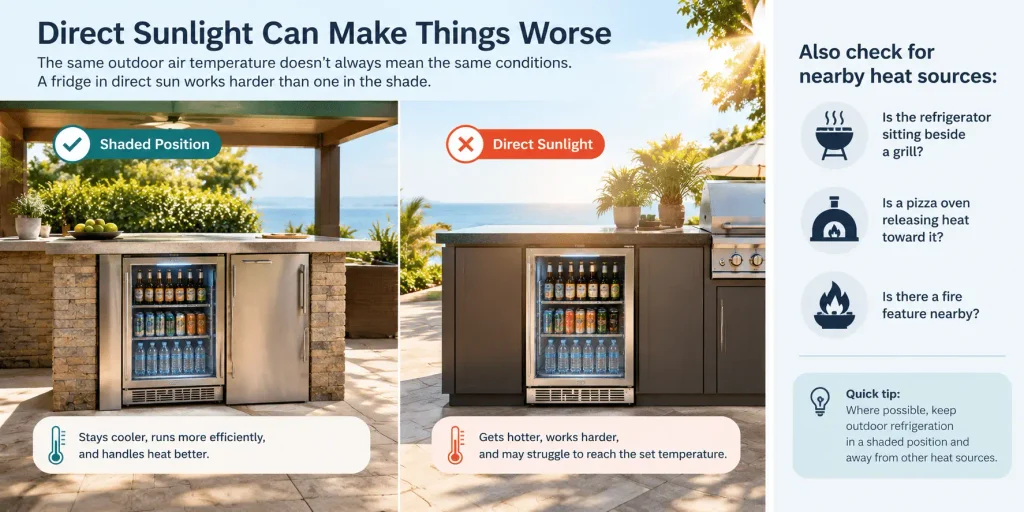
Direct Sunlight Can Make Things Worse
Let us compare two refrigerators.
One is placed underneath a shaded outdoor counter. The other one is installed in full afternoon sun that too, beside a dark countertop.
They may be exposed to the same outdoor air temperature, but the conditions around the cabinets are not the same.
Direct sunlight can heat the refrigerator’s exterior and the surrounding cabinet. That can add more heat for the cooling system to deal with.
Hence for better cooling you should always install outdoor refrigeration in a shaded position. Also make sure you look around it. Check out for the following:
- Is the refrigerator sitting beside a grill?
- Is a pizza oven releasing heat toward it?
- Is there a fire feature nearby?
Such details can be easy to miss. But when you are planning an outdoor kitchen with a fridge they can matter a lot. Especially once the equipment has to run on a hot day.
What Ambient Temperature Is Too Hot for a Refrigerator?
First let us explain what is ambient temperature.
Ambient temperature is the temperature of the air surrounding the refrigerator or appliance.
For an outdoor fridge, it means the actual outdoor conditions around the unit. They can affect how hard the refrigerator has to work to remove heat.
However, there is no single ambient temperature that applies to every refrigerator. Different models have different rated operating environments. This is why the manufacturer’s ambient temperature specification matters.
For example, SUNNAI’s SY-51 outdoor beverage cooler lists an ambient operating range of 16–38°C. Therefore, its product specifications should be well-thought-out against the actual conditions of the installation site. You should not assume that “outdoor” means suitable for any temperature.
The same principle applies to other brands. For a commercial project, you should not look only at the average annual climate. You should think about the hottest period the equipment is expected to operate through.
That is when cooling problems of outdoor refrigerators are most likely to show up.
2. Check the Refrigerator Clearance and Ventilation
How Much Clearance Does an Outdoor Refrigerator Need?
This is one of those questions that sounds simple. But it does not have one universal answer. Why?
Because refrigerators use different ventilation designs.
For instance a freestanding unit may need airflow around the back, sides or top. A built-in outdoor beverage cooler model may be designed to release heat through the front.
So you should avoid using a random clearance measurement from another refrigerator.
The installation instructions for the exact model should be considered. This is very important when the refrigerator is being installed underneath an outdoor countertop.
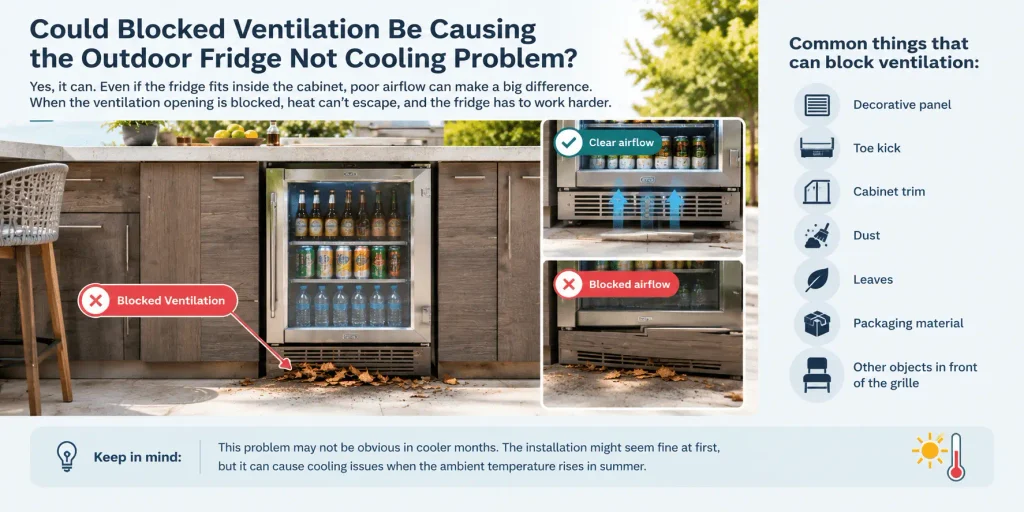
Could Blocked Ventilation Be Causing the Outdoor Fridge Not Cooling Problem?
Yes, it can be.
A refrigerator can physically fit inside a cabinet. It can still have a poor installation. For example, the ventilation opening may be partly covered by:
- A decorative panel
- A toe kick
- Cabinet trim
- Dust
- Leaves
- Packaging material
- Other objects placed in front of the grille
When airflow around the refrigerator is restricted, it becomes harder for the heat to escape. Hence, the refrigerator has to work harder to remove that heat.
This is also why an outdoor fridge ventilation problem may not become obvious until the summer comes. The installation might appear fine during mild weather. But it may struggle when the ambient temperature rises.
Avoid Building a Sealed Box Around the Refrigerator
This point is important for outdoor kitchen designers and cabinet manufacturers.
The refrigerator needs a proper route for heat to exhaust. When warm air is discharged into a small or enclosed cavity, it will have nowhere to go. This same warm air can build up around the appliance causing problems.
So when checking an installation, you should not only measure the refrigerator. Instead you should look at the whole cabinet space.
Things that you should confirm before fabrication include the following:
- Appliance width, depth and height
- Required cutout dimensions
- Ventilation direction
- Door swing
- Electrical access
- Service access
- Cabinet depth
- Airflow path
This can be fixed easily on a drawing board. But after the countertop and cabinetry are already finished, it can be difficult and expensive.
3. Check How the Refrigerator Is Being Used
Sometimes it is not the outdoor refrigerator that fails to cool. It is simply being asked too much to do than its capacity.
Frequent Door Opening Requires More Work
Take an example. May be you are having a pool party. Someone opens the refrigerator for water. Then another person grabs a soda. Then someone puts several warm bottles inside.
Every few minutes, or even seconds later, the door opens.
This repeated door opening activity allows warmer air into the refrigerator and it increases the cooling demand.
The same thing happens in a hotel pool bar or busy hospitality setting. Infact there it can happen on a larger scale.
So if the outdoor refrigerator seems warmer during a busy period, you should look at the usage pattern before assuming there is a fault in it.
Why Is My Fridge Warm After I Restock It?
When you fill a refrigerator with lots of new drinks that are at room temperature it requires time to cool those drinks down. This is noticeable if a large number of warm bottles or cans are loaded at once.
For example, a pool bar may load its beverage stock shortly before service starts. The refrigerator then has to cool all those products. And the staff are also opening the door repeatedly.
So, the cooling performance of an outdoor refrigerator should be gauged immediately after a large restock. Instead, check whether it recovers once:
- The drinks have had time to cool
- Door traffic decreases
- No more warm beverages are being added
If the temperature returns to normal, the issue may be related to the cooling load rather than a failed appliance.
Avoid Overpacking of the Refrigerator
More drinks do not always mean better use of space. If the cabinet is packed so tightly that air cannot circulate properly. Hence the cooling of the outdoor beverage cooler can become less effective.
You should try to keep the internal air outlets clear. This is important for beverage coolers used during busy events. Here the staff are often tempted to fill every available space. Capacity of the fridge is advantageous only when it can still effectively circulate cold air.
4. Check Cleaning and Basic Maintenance
Outdoor refrigerators are prone to lots of dust and debris as compared with indoor units. There may be pollen, leaves, grease, dust and other material around the ventilation areas. Over time, this can restrict airflow.
Check the Ventilation Area Before Calling for Service
Take a look at the accessible ventilation openings.
- Is there dust around the grille?
- Are leaves blocking the opening?
- Has grease from the nearby cooking equipment collected in the area?
If so, you should clean the accessible areas according to the manufacturer’s maintenance instructions. Do not remove components. Do not attempt refrigeration-system repairs yourself unless you are qualified to do so.
Why Does the Fridge Work Better in Winter Than Summer?
A partially restricted ventilation area may not cause an obvious problem when the weather is mild. Then summer arrives.
The outdoor air is hotter. The refrigerator has to reject more heat. The restricted airflow suddenly becomes much more noticeable.
For hotels, resorts, clubs and other hospitality properties, a seasonal inspection before the hottest period can therefore be worthwhile.
5. Check the Door, Temperature Setting and Internal Loading of the Fridge
You should not assume that your outdoor fridge not cooling problem is because of a major breakdown. Instead you should first some basic checks like the following:
Check the Temperature Setting
Make sure someone has not accidentally changed the thermostat. This can often be overlooked in shared commercial spaces. There are several staff members that use the same equipment. Therefore such things can happen.
Check the Door Seal
The door should close properly. Sometime there could be a problem with the gasket. It might be preventing a complete seal.
A door that does not close properly can allow warm air into the cabinet continuously.
Check What Is Stored Inside
Answer the following questions:
- Are the shelves packed too tightly?
- Are internal air outlets blocked?
- Has a large amount of warm product just been added?
- Is the refrigerator being opened constantly?
These simple checks can tell you a lot about the outdoor fridge it cooling. Then you can move on to more complicated troubleshooting.
6. Choose Outdoor Refrigeration for the Actual Installation
This is where many cooling problems can be prevented before they happen. An outdoor refrigerator should not be selected solely on capacity or physical fit. Its rated operating conditions, ventilation design and installation requirements must also match the project.
Can I Put an Indoor Refrigerator Outside?
No. Both are designed and manufactured differently. They are for different purposes. Outdoor installations cause the refrigeration to be exposed to heat, humidity, temperature changes and heavier usage.
The cabinet may also be integrated into an outdoor kitchen. Here the ventilation is limited. That is very different from an indoor kitchen.
So for an outdoor project, you should look at the following features:
- Ambient operating range
- Cooling system
- Ventilation design
- Construction materials
- Installation type
- Temperature range
- Cabinet dimensions
- Service access
- Relevant approvals or certifications
The point to keep in mind is simple. Always choose the refrigerator first. Then design the cabinet around its requirements.
SUNNAI Outdoor Beverage Cooler: A Practical Project Example
SUNNAI’s outdoor beverage coolers provide a useful example of how these decisions come together.
Take the SY-51D built-in outdoor beverage cooler.
It is designed for built-in outdoor kitchen installation. When installed under countertops or within cabinetry, it utilizes the front ventilation to help dissipate heat. Its published specifications include
- 92L gross volume
- 18-bottle + 60-can capacity
- compressor cooling
- 304 stainless-steel construction
- 16–38°C ambient operating range
- It also has a 3–20°C temperature range and touch control.
Knowing these outdoor fridge conditions is valuable. This is because a project team can use those specifications. They can easily check whether the appliance suits the installation requirements or not.
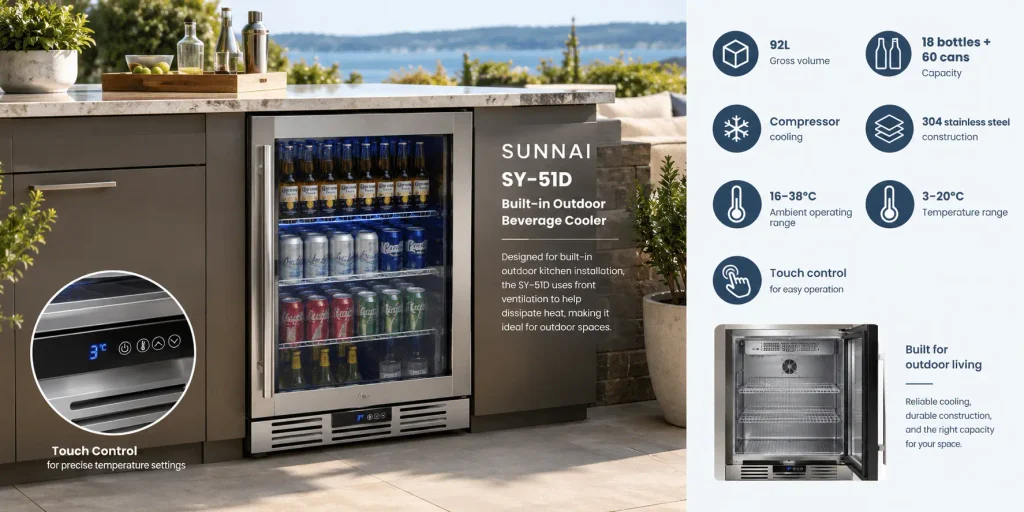
For example, if you have a cabinet that is enclosed, the front-ventilation design is required for optimal working. But that does not mean the cabinet can simply be sealed around the refrigerator. The required airflow path still needs to be considered too.
The ambient rating matters too.
If a project regularly experiences temperatures close to or above the product’s specified operating range, the buyer should address that before finalizing the equipment.
The SY-51 offers another example.
It has a published 150L gross volume and 132-can capacity. It uses compressor cooling. It has 304 stainless-steel construction and is specified for an ambient range of 16–38°C.
SUNNAI describes it as suitable for freestanding or integrated placement. That gives a buyer two useful lessons.
- First, capacity is only one part of the decision of selecting the best outdoor fridge for their requirements.
- Second, installation conditions have to match the product specification.
Hence you should use this type of specification process to avoid a common mistake: Buying a refrigerator first and discovering later that the climate, cabinet, airflow,or usage pattern does not suit it.
Fix the Environment Before Blaming the Refrigerator for Not Cooling
When an outdoor fridge is not cooling properly, you should not jump straight to the conclusion that the appliance has failed.
Start with the environment.
Check these things in order:
- Ambient temperature — Is the refrigerator operating within its rated conditions?
- Sun exposure — Is direct afternoon sun heating the cabinet?
- Nearby heat — Is it beside a grill, pizza oven, or fire feature?
- Ventilation — Can hot air actually escape?
- Clearance — Was the cabinet designed around the refrigerator’s requirements?
- Door usage — Is the door being opened constantly?
- Loading — Were large quantities of warm drinks recently added?
- Cleaning — Are dust, leaves, or grease affecting ventilation?
- Settings and seals — Is the thermostat correct and is the door closing properly?
- Product specification — Is the refrigerator actually suitable for the outdoor environment?
If the problem remains after these checks, then it may be time to involve qualified service personnel.
For a new outdoor kitchen, pool bar, hotel, resort, or hospitality project, though, prevention is much easier.
Select equipment for the actual climate. Check the ventilation design before the cabinets are built. Plan service access. And make sure the refrigerator’s rated operating conditions match the place where it will be used.
A little planning at the beginning can save a lot of frustration later.
FAQs
Why is my outdoor fridge not cooling when the weather gets hot?
High ambient temperature can increase the cooling load. Direct sunlight, blocked ventilation, frequent door opening, warm drinks, and dirty ventilation areas can make the problem worse.
What ambient temperature is too hot for an outdoor refrigerator?
There is no universal limit. Check the ambient operating range specified for the exact refrigerator model and compare it with the hottest expected conditions at the installation site.
How much clearance does an outdoor refrigerator need?
It depends on the model and its ventilation design. A freestanding refrigerator and a front-vented built-in refrigerator may have very different installation requirements. Always follow the manufacturer’s instructions.
How much space should be around a refrigerator for ventilation?
There is no single number for every model. Check where the appliance releases heat and follow the manufacturer’s specified installation requirements. Never block a ventilation grille.
Can direct sunlight stop an outdoor refrigerator from cooling?
Direct sunlight can add heat around the appliance and increase the cooling load. Shading the refrigerator and keeping it away from other heat-producing appliances can help reduce that extra load.
Why does my outdoor fridge run all the time?
Hot weather, frequent door opening, warm drinks, direct sunlight, restricted ventilation, or a dirty ventilation area can all increase compressor run time. If the refrigerator cannot eventually reach its normal temperature, further troubleshooting may be needed.
Can I put a normal indoor refrigerator in an outdoor kitchen?
Do not assume that an indoor refrigerator is suitable for outdoor installation. Check the manufacturer’s intended environment, ambient temperature range, ventilation requirements, and installation instructions before using any appliance outdoors.