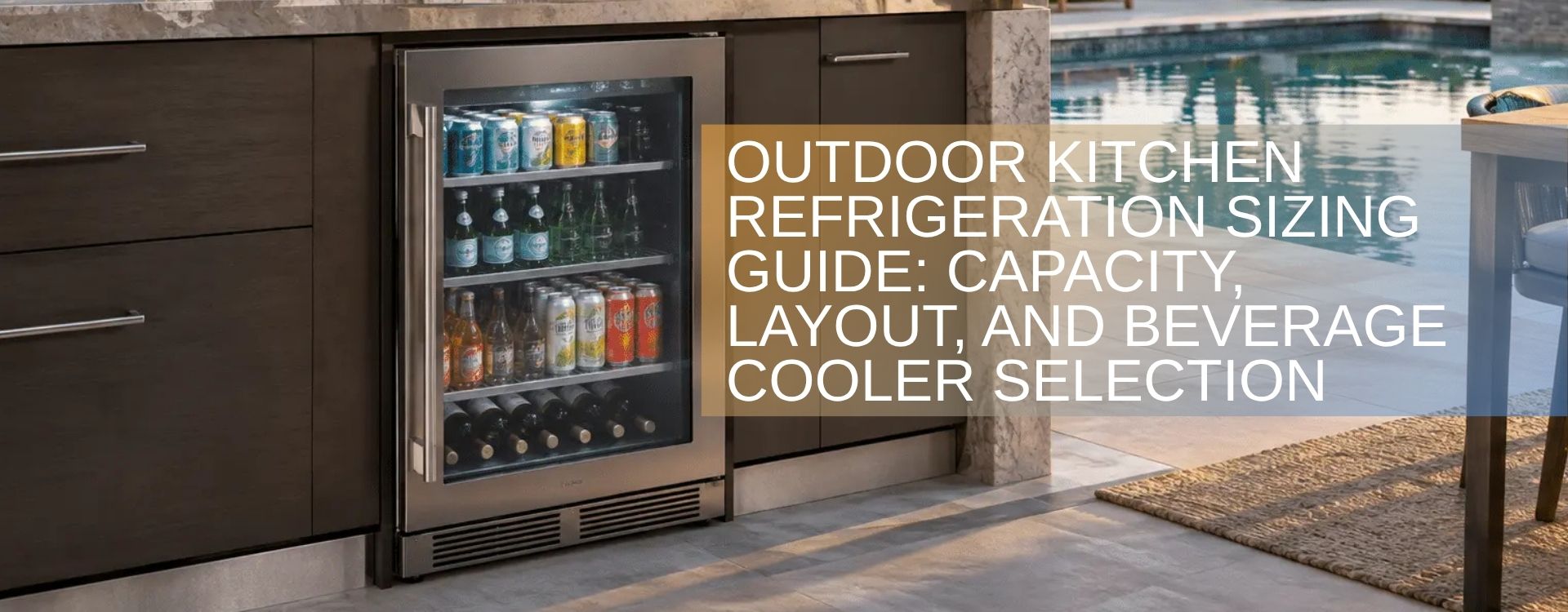
Some people think that selection of a refrigeration for an outdoor kitchen or pool bar is only about selecting the largest refrigerator. Or maybe a fridge that fits the space. But that is not the case.
The right type of outdoor fridge should have a specific capacity. This size or capacity depends on how many people are served in that area. It is also influenced by on what beverages need to be stored in it. You need to know how often staff can restock and how much product needs to be available during peak periods.
In that view, a family outdoor kitchen may only need refrigerator with a space for drinks during dinner and weekend gatherings. A villa pool bar, hotel, club or hospitality project may need several hours of beverage stock available. There should not be a need for constant replenishment. The refrigeration also has to be suitable for the physical limits of the outdoor kitchen. This includes cabinet dimensions, door clearance, ventilation and exposure to heat and moisture.
In this guide we will explain how to select the right beverage refrigerator for outdoor usage. You will understand how to calculate the size of the outdoor refrigerator and connect capacity with the practical requirements of an outdoor installation.
1. Start With Demand: What Does the Outdoor Kitchen or Pool Bar Need to Store?
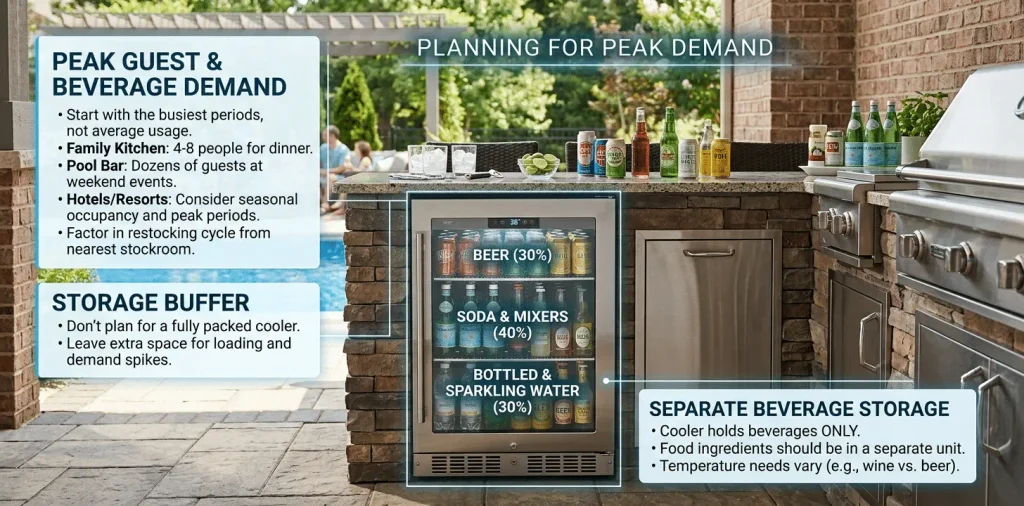
Estimate Peak Guest and Beverage Demand
When selecting an outdoor beverage cooler or refrigerator the first step is to start with the busiest realistic period not just an average usage.
- A family outdoor kitchen may serve four to eight people during dinner.
- A pool bar may serve dozens of guests during a weekend event.
- Hotels, resorts, and clubs should also consider seasonal occupancy. They should count in the events and peak service periods.
Next you should estimate how many drinks need to stay cold between restocking cycles. This is very important if the nearest stockroom is not close by.
Addition of a Capacity Buffer
You should not plan for a beverage cooler to remain completely full all the time. There should be extra space. It will make loading easier and will also leave room for demand spikes.
Separate Beverage Storage From Food and Specialty Storage
You should be clear about what the beverage cooler actually needs to hold.
Typical beverages may include:
- Beer
- Soda
- Bottled water
- Sparkling water
- Mixers
- Canned drinks
Food ingredients should not be counted as the beverage capacity if a separate refrigerator will handle them.
Also make sure to think about the temperature requirements. Wine, frozen products, food ingredients and ice may need different equipment or temperature ranges.
How Often the Bar Can Be Restocked
A smaller outdoor cooler for drinks may be enough when indoor backup storage is nearby. However, for commercial locations, longer replenishment routes are there. Hence you need more cold storage capacity.
A hotel pool bar or rooftop bar may need more independent storage than a residential patio.
2. Convert Demand Into the Right Refrigeration Capacity
Size by Usable Capacity, Not Exterior Dimensions Alone
Liters and cubic feet are useful starting points for this step. However, shelf arrangement and beverage format can affect usable storage.
Cans, wine bottles, tall cans, water bottles and mixers all utilize space in a refrigerator differently. When the beverage mix changes from one project or season to another then the adjustable or removable shelving can be particularly useful in an outdoor fridge.
One should select an oversized outdoor refrigerator just because there is ample of cabinet space. A larger refrigerator can consume valuable island space. It will not provide useful capacity for the operation.
The goal is usable refrigeration and not the biggest cutout.
Decide Between One Large Unit and Multiple Refrigeration Zones
When the beverage program is simple and most drinks have similar storage requirements then one cooler can work well. It can also make installation and maintenance more simple and easy.
If you have larger bars they require multiple refrigeration points. One unit can support preparation of drinks. Another section can serve guests or bartenders. This reduces unnecessary movement during busy service.
For hotels, clubs, resorts and high-use pool bars, multiple units can also provide operational redundancy.
Match Refrigeration Size to the Available Outdoor Kitchen Footprint
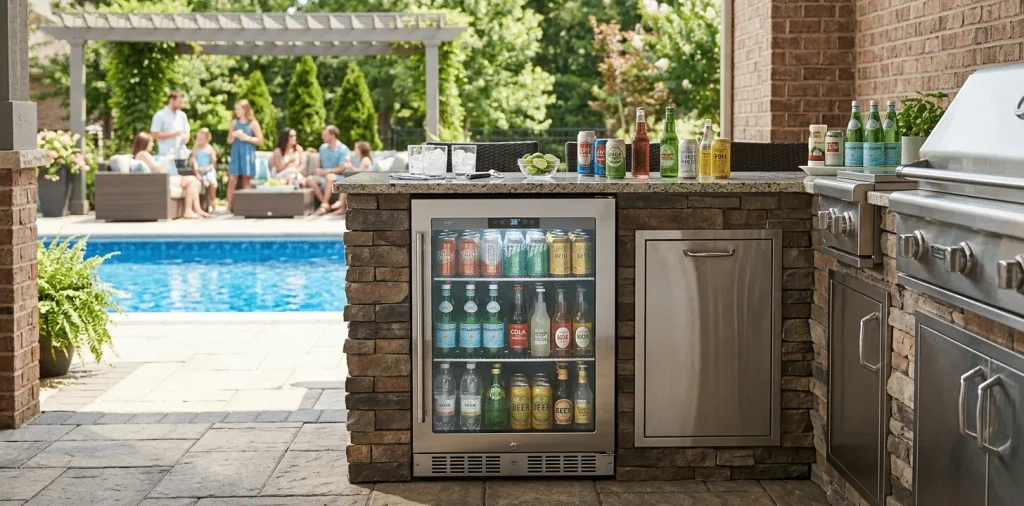
Before finalizing the appliance you want to buy, you must reserve the cabinet space for it. Check width, depth, counter height, door movement and neighboring appliances present there.
From the beginning the refrigeration should be part of the layout. It should not be something added after the cabinetry is designed.
Ventilation is also important. It should be part of this calculation. Built-in refrigeration equipment requires professional installation arrange in a way that it preserves the manufacturer’s needed airflow.
3. Size Refrigeration Around the Way the Bar Actually Operates
Residential Outdoor Kitchen: Prioritize Convenience
In most homes there is already an indoor refrigerator in place. Hence there is back up storage. In such cases the requirement is of a smaller outdoor cooler.
Like the capacity, the placement of the outdoor fridge matters as well. A cooler beside the outdoor bar can reduce repeated trips into the house. It will help keep water, soft drinks, beer and ready-to-serve beverages close to the people using the space.
Hospitality Pool Bar: Size for Service Flow and Turnover
For a commercial pool bar, you should calculate capacity around the service interval. How much stock must remain cold before staff can make the next replenishment run?
Busy periods should determine the design.
In some projects, several compact units can perform better operationally than one centralized refrigerator.
SUNNAI Outdoor Beverage Cooler as a Project-Sizing Example
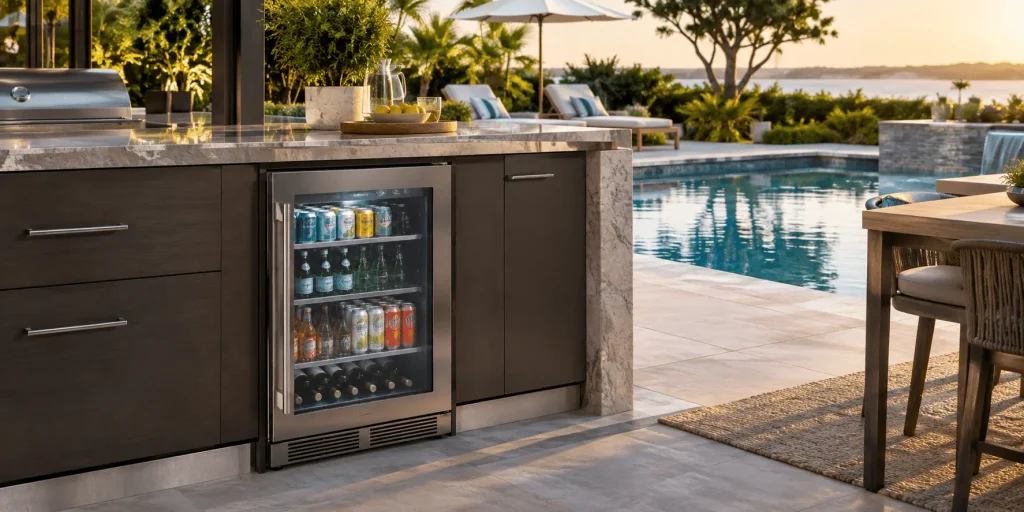
Here is an example of a product. It can help make sizing easier to understand. SUNNAI’s SY-51D built-in outdoor beverage cooler. It has a gross volume of 92L. It is specified for 18 bottles and 60 cans. That does not mean every project needs one unit.
It gives a project planner a reference point.
For instance, there is a small outdoor bar. It will need roughly one unit’s worth of chilled beverage stock between restocking cycles. The SY-51D outdoor beverage cooler can be evaluated as a single refrigeration point. If projected demand is significantly higher, then event planners can compare the combined capacity of two or more units. They should not assume that one larger refrigerator is automatically better for that location.
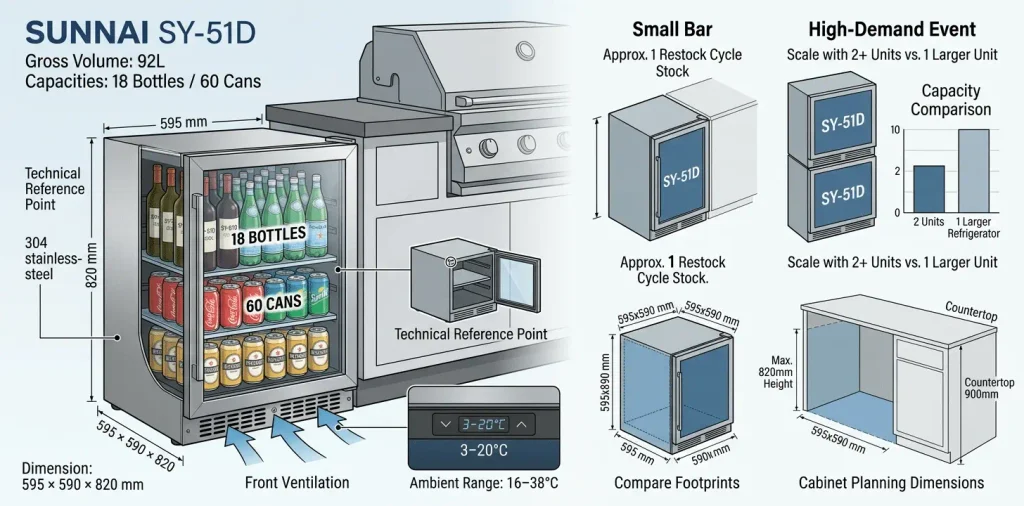
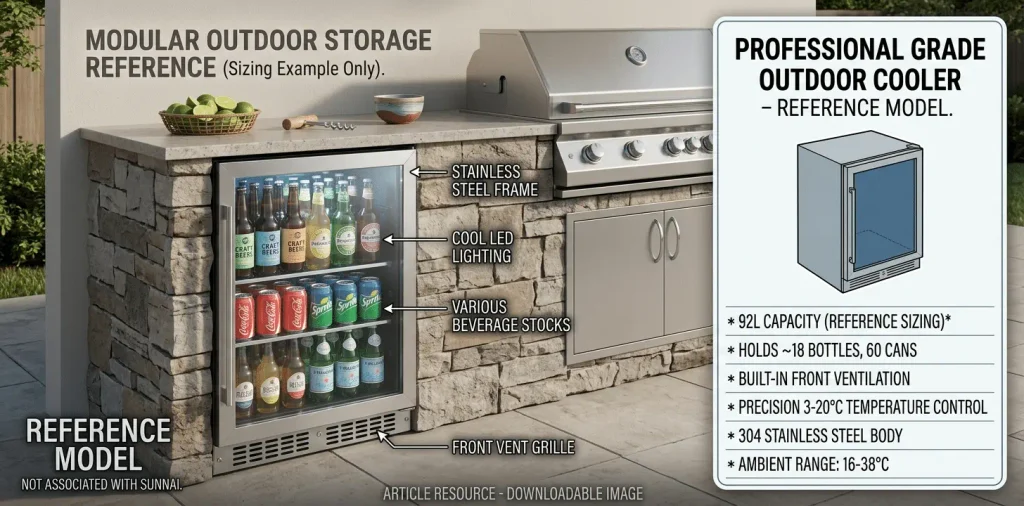
The model in discussion is designed for built-in installation with front ventilation. It is useful under counters or inside cabinetry. It uses compressor cooling. It has a 304 stainless-steel body and cabinet. There is touch control, adjustable storage and a 3–20°C temperature range. The specified ambient range is 16–38°C.
Knowing the dimensions of the body of the outdoor fridge is quite useful during cabinet planning. In case of SY-51D outdoor beverage cooler it is 595 × 590 × 820 mm. Teams can compare that footprint with the available opening, adjacent appliances, countertop height and required service space before fabrication.
For B2B buyers, the specification process should go beyond capacity. Developers, outdoor-kitchen companies, distributors, appliance brands and hospitality operators should confirm dimensions, installation type, electrical requirements, environmental conditions, certifications, quantities and customization requirements before procurement.
SUNNAI also offers OEM/ODM for outdoor refrigerators. This includes manufacturing of beverage coolers, wine coolers, drawer refrigeration, ice makers and kegerators. Its manufacturing operation is supported by a 20,000-square-meter facility and stated annual output above 150,000 units.
4. Check the Installation Conditions Before Finalizing Refrigeration Size
Outdoor Conditions Can Change the Required Specification
Pool bars may experience humidity, splash exposure and changing weather. You should specify equipment for the actual environment.
SUNNAI’s outdoor refrigeration range, for example, is described as using IPX4-rated protection. There are anti-condensation features and UV-resistant materials.Outdoor suitability does not automatically mean the appliance is designed for year-round operation in freezing conditions. The operating range of an individual model should always be checked before specification.
Verify Built-In Ventilation and Door Clearance
The product dimensions should not be treated as the complete installation proportions. You need to confirm ventilation direction, cabinet opening, depth, handle projection, door swing and service access for this as well.
For undercounter installations, protect the ventilation path from toe kicks. Keep in view the decorative panels or incorrectly designed cabinetry.
A front-vented unit can support integrated installation. However, this is applicable only when the installation follows the manufacturer’s requirements.
Create a Refrigeration Schedule for Larger Projects
For larger projects or events you should create a refrigeration schedule listing. This include the following elements. You should consider these elements before selection of the outdoor refrigerator.
- Location
- Product type
- Required beverage capacity
- Dimensions and cabinet cutout
- Electrical supply and ventilation
- Environmental requirements
- Required certifications
- Quantity
Make sure to do a comparison of the projected peak storage with combined usable capacity before procurement. You can add capacity where operational continuity or future expansion matters.
Conclusion: Size Your Outdoor Refrigeration Around Demand, Not Guesswork
After going through all the above considerations one thing is quite clear: there cannot be one universal refrigerator size for every outdoor kitchen or pool bar. Different locations, purposes and events have different outdoor refrigeration requirements.
A residential project may need one compact beverage cooler. A hotel, resort, villa development or commercial pool bar may work better with several distributed refrigeration points.
If you procuring for B2B projects, you should give the manufacturer the information needed to make a proper recommendation. This can include expected beverage volume, peak demand, installation dimensions, environmental conditions, electrical requirements and projected quantities.
This helps to make the outdoor refrigeration selection process more accurate and not just guess work on what look bigger or better.
FAQs
How much refrigeration is needed for an outdoor kitchen?
The size the outdoor beverage cooler or refrigerator should be around the number of drinks that must stay cold between restocking cycles. There should be additional room for peak demand and practical loading.
What size refrigerator is best for an outdoor kitchen?
There is no one best size of outdoor fridge. The right size to buy is the one that provides enough usable beverage capacity without taking unnecessary cabinet space. A smaller outdoor kitchen may need only one compact unit. Similarly for larger projects there may be a requirement for several units.
How do I calculate beverage cooler capacity for a pool bar?
You need to follow some necessary steps to calculate the rights size of beverage cooler you need for a pool bar. These steps include estimation of peak guests, number of drinks that will be consumed between restocking cycles, beverage types that will be stored and the required capacity buffer. Then you can compare that requirement with the usable capacity of the selected cooler or combined units.
Is one large refrigerator or two smaller refrigerators better for an outdoor bar?
It depends on workflow and your requirements. Two units can distribute drinks between preparation and serving areas. They can provide some redundancy. One unit may be simpler for a smaller operation.
How much refrigerator capacity does a commercial pool bar need?
There is no single figure for this capacity. The storage capacity of an outdoor fridge depends on different factors like peak occupancy, service turnover, restocking frequency, beverage mix and how far the bar is from backup storage.