Introduction: Staying Outside and Running Year-Round Are Not Always the Same Thing
The modern outdoor living area has moved very quickly from being just a patio with a standalone grill to becoming a fully integrated part of the home’s main entertainment zone. This change is causing a great deal of demand for permanent, commercial-quality outdoor cold storage. The most common question that we receive from homeowners is whether a specially constructed outdoor fridge can remain outside all 365 days of the year despite changing seasonal conditions.
The short answer is yes, but with some important exceptions. These refrigerators are designed to stay outside all year if they are suitable for the climate zone in which you live. It is also necessary to carry out maintenance in accordance with the seasonal procedures. It’s critical to understand that a standard indoor refrigerator used outdoors will suffer rapid mechanical failures. The conditions also pose serious electrical hazards and will lead to spoilage of the stored items.
Therefore, it’s important for homeowners or any other operators to specify equipment reliability for all four seasons. These users include:
- Hospitality Operators
- Outdoor Kitchen Designers
- Distributors
- Appliance Brands
This detailed technical guide thoroughly looks at the engineering involved in weatherproofing, together with the winter thermodynamic problems. It also sets out exact protocols for electrical installation, ventilation requirements, and the best choices of style.
1. What Determines Whether an Outdoor Refrigerator Can Stay Outside Year-Round?
1.1 Outdoor-Rated Construction Comes First
304-Grade Stainless Steel and Corrosion Resistance
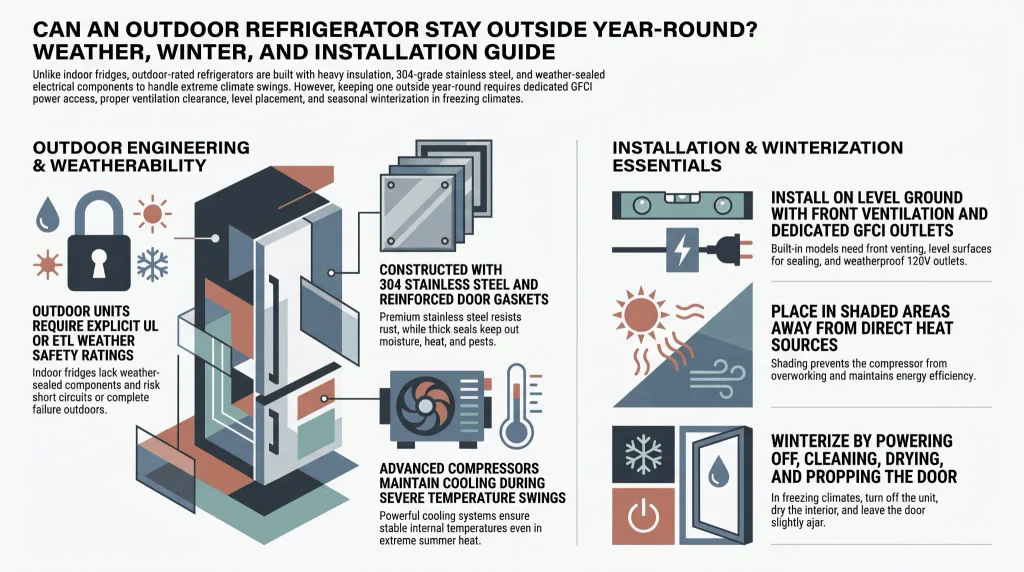
An outdoor refrigerator’s structural integrity starts with the quality of its metal. It must withstand environmental deterioration from harsh outdoor conditions. Outdoor refrigerators using 304 stainless steel frames, which are rich in nickel and chromium, offer the highest level of corrosion protection. In comparison, regular indoor refrigerators use 430 SS, which is not as durable. Some alternative indoor models rely on coated mild steel or painted plastic surfaces, which tend to develop pits when exposed to outdoor humidity.
In addition to the type of metal used, the outdoor cabinets have externally wrapped, seamless welded joints to prevent rain from running off. This barrier also keeps dust and other biological matter from getting into the cabinet joints. All internal fittings are made from anti-corrosion stainless alloy. This includes shelf slides and heavy-duty door hinges. The exterior mounting screws are also made from the same type of metal.
304 stainless steel forms a fine layer of chromium oxide when it comes into contact with oxygen. The layer protects the core material from galvanic corrosion. This is effective even in high-humidity outdoor conditions.
Advanced Thermal Insulation and UV-Resistant Sealing
Irrespective of the changing weather conditions outside, the refrigerator has to maintain a steady temperature inside. A standard refrigerator does not have enough thermal insulation to restrict heat transfer in challenging situations. The outdoor units are fitted with much thicker insulation made from high-density polyurethane foam in order to maintain stable internal temperatures despite strong external thermal radiation. Strong, UV-resistant magnetic door seals are used to produce a tight and airtight fit that prevents ambient heat and humidity from getting in. These seals also keep dust out and keep invasive outdoor insects from entering.
Rear Cabinet Shielding and Glass Moisture Control
A solid rear cover plate is provided to protect the delicate condenser coils. This cover shields the electrical wiring from dust blown by the wind and also keeps rodents from nesting in the unit and stops the accumulation of moisture, which could lead to damage. With respect to units that have display features, multi-pane glass doors make use of heated internal frame components. In other cases, insulating argon gas fills are used in order to prevent the glass from fogging during humid summer days.
IPX4 Waterproofing and Tropical-Rated Compressors
High-grade outdoor appliances also have an IPX4 splash-proof construction, which successfully stops fluid from getting in during heavy rainstorms. They are just as effective at dealing with snowmelt as high-pressure deck washdowns. In order to cope with such conditions, tropical-rated compressors make use of motors with higher displacement that are designed to provide continuous cooling cycles without reaching their thermal overload limits.
Some advanced outdoor units are equipped with heated condensate drain pans and make use of fan-assisted versions to deal with the high amount of internal moisture that accumulates during the humid summer months.
A Comparison of the Construction of Indoor and Outdoor Refrigerators
| Feature / Component | Standard Indoor Refrigerator | Purpose-Built Outdoor Refrigerator |
| Exterior Metal Grade | 430 Stainless Steel or Painted Mild Steel | 304 High-Grade Corrosion-Resistant Stainless Steel |
| Climate Classification | Class N (Normal: 16°C to 32°C) | SN-T (Subnormal-Tropical: 16°C to 43°C) |
| Ingress & Safety Rating | Standard Indoor Electrical Safety | UL/ETL Outdoor Rated & IPX4 Splash Protection |
| Cabinet Ventilation | Rear or Side Passive Heat Dissipation | Front-Venting Toe-Kick Grill for Built-In Enclosures |
| Gaskets & Insulation | Soft Vinyl Gaskets / Standard Foam | UV-Resistant Reinforced Gaskets & High-Density Foam |
| Compressor Cooling System | Low-Displacement Gravity/Passive Coils | High-Torque Compressor with Forced-Air Convection |
1.2 Ambient Temperature Range Sets the Real Operating Limit
High-Temperature Performance and Heat Tolerance
Outdoor refrigerators that are specially designed have robust mechanical tolerances and are therefore able to function safely in a surprisingly broad range of ambient temperatures. While indoor models have this feature, high-end outdoor refrigerators can cope with extremely hot summer conditions above 100°F (38°C to 43°C) without suffering thermal failure. The combination of high-efficiency compressors and dynamic forced-air cooling stops the interior temperature from rising, even when there is intense solar exposure. Moreover, specialized outdoor units are equipped with completely sealed chassis so as to endure high levels of ambient humidity and also resist corrosion caused by coastal air.
Thresholds for Cold Weather and Placement Impact
On the colder side, standard refrigeration cooling cycles work reliably down to ambient temperatures ranging from about 50°F to 60°F. Below this temperature limit, the cooling process undergoes a significant change. The position of the units is of great importance since those placed in full shade stay at thermal equilibrium with much less strain on the compressor. Compared to units that are exposed to direct solar radiation, these shaded units use considerably less energy.
SN-T Climate Classifications and Safety Ratings
In order to check whether an appliance can withstand severe weather conditions, engineers use strict and standardized climate classifications. Outdoor refrigeration equipment that is of high quality is constructed to meet Subnormal-Tropical (SN-T) climate ratings, which ensure that it will function steadily within ambient temperatures ranging from 16°C to 43°C (61°F to 109°F). Those equipped with UL or ETL outdoor safety ratings have had their internal electrical components and wiring harnesses subjected to rigorous moisture testing, and the junction boxes are also tested for splash resistance.
1.3 Installation Conditions Can Change Real-World Performance
The placement of the appliance matters. It directly affects its reliability and longevity. It is recommended to fit the refrigerator on a solid and level concrete pad. A heavy stone paver base and a structurally reinforced wooden deck are also acceptable. If the cabinet is not level, it will cause the frame to distort, which in turn results in the doors becoming misaligned. This then leads to air leaks in the gasket and eventually to poor condensate drainage within the unit.
It is also important to position the cooling unit in a shaded area. It should be placed underneath a covered patio. Heavy pergolas provide good protection, and so does a shaded corner of the island, away from direct exposure to the afternoon sun. There must be a strict minimum gap of 12 to 24 inches for thermal isolation between the fridge and any high-heat appliances.
2. What Happens to an Outdoor Refrigerator Through Different Seasons?
2.1 Winter: Low Temperatures Can Be More Complicated Than They Look
The Thermostat Paradox
The effect of outside temperatures on mechanical thermostats is critical. The compressor in a typical refrigerator is powered on and off in response to the cooling demand determined by the internal temperature sensor. The thermostat cuts off the compressor as soon as the outside temperature drops below the refrigerator’s internal setpoint. It thinks the cabinet is cold enough even though it can’t detect the actual temperature. The compressor then shuts out entirely.
Risks to Stored Food and Beverages
When the refrigerator has a freezer compartment, a prolonged compressor lockout will slowly raise the temperature of the freezer area to that of the surrounding environment, leading to frozen food thawing unintentionally. Additionally, canned drinks that are left in a fridge that is not working during cold weather will become completely frozen. Glass bottles undergo the same situation, expand as a result, and break, causing serious liquid damage. Heavy frost accumulation and hazardous ice damming around the evaporator coils also occur because of the cold air outside and the internal residual humidity.
2.2 Summer: High Ambient Temperatures Increase Cooling Load
Heavy-Duty Cooling and Electrical Safety
A refrigeration unit used outdoors has to deal with heavy heat loads while at the same time ensuring absolute electrical safety in damp conditions. The heavy-duty compressors with high displacement have up to three times the cooling torque of those used indoors and so are able to quickly reduce the temperature when the surrounding air heats up above 100°F. Strong internal fans that use forced air continuously circulate the cold air around the cabinet to avoid the formation of hot spots. Safety is a top priority, which is why the delicate wiring terminals are placed inside weatherproof electrical enclosures. Both the relay switches and the digital controllers are given the same kind of sealing to prevent short circuits. The appliance conforms strictly to UL 471 safety standards, having successfully undergone rigorous ground-fault tests, as well as passing rain impact tests and dielectric withstand tests.
Variable-Speed Systems
Outdoor compressors use variable-speed or dual-stage cooling systems that adjust the motor’s revolutions per minute according to readings from real-time ambient sensors, thereby preventing the mechanical parts from experiencing thermal runaway in extreme heat.
The Impact of Frequent Door Openings
The frequency of door openings during peak outdoor entertaining adds a substantial secondary heat load. In commercial and hospitality settings, quick cooling recovery and strong door sealing are equally important. Both factors are essential for maintaining safe internal temperatures.
2.3 Rain, Humidity, and UV Exposure Affect Long-Term Durability
If ambient sunlight strikes dark stainless steel or glass doors, it can cause their temperature to rise. The thermal absorption by the surface can raise the temperature of the cabinet casing by as much as 30°F above the surrounding air temperature. Since this situation arises, it is necessary to use glass coatings that reflect ultraviolet radiation in order to reduce the transfer of radiant heat.
Reinforced outdoor door gaskets use special synthetic rubber compounds designed to resist damage from ultraviolet radiation and remain elastic without cracking even when subjected to extreme temperature fluctuations from summer to winter.
3. How to Keep a Year-Round Outdoor Refrigerator Reliable
3.1 Build the Refrigerator Into the Outdoor Kitchen Correctly
Getting the airflow right is the most important thing in increasing the lifespan of an outdoor compressor. Any built-in undercounter refrigerator must have a compulsory front-venting louver that actively draws in the intake air and then releases the hot air through the front surface. If you install a rear-venting freestanding unit inside custom cabinetry, heat will be trapped, causing the compressor to shut down rapidly and thereby permanently voiding the manufacturer’s warranty. Allow at least 1 to 2 inches of clearance at the rear of built-in cabinets to enable the necessary supplementary air circulation. You’ll also need to remove trash around the toe-kicks, like dust, fallen leaves, and pet hair, frequently. Also, clear the front louver to prevent limited airflow through the condenser.
Beyond ventilation, planners should provide exact door clearance so that doors and drawers may open all the way without hitting surrounding masonry or exterior hardware. Adequate physical access must also be provided for future electrical inspections, condenser maintenance, and technical service.
3.2 Use Seasonal Maintenance Rather Than Treating the Unit as Maintenance-Free
It is absolutely essential to properly switch off an outdoor refrigerator before the first occurrence of freezing weather if you want to make sure the unit will survive until spring. In sub-freezing climates, you must adhere to this strict procedure:
- When switching off the power, make sure that you have done so completely before the first severe freeze occurs (a freeze that is consistently below 32°F / 0°C).
- To complete the removal of the products, all food and canned drinks must be taken away, as well as any glass bottles and perishable items, so that they won’t expand because of freezing.
- For defrosting and cleaning the moisture, let the internal evaporator coils fully defrost and then clean all the inside walls thoroughly. Take out and clean the drawers, and use a gentle antibacterial solution to wipe the shelves.
- To clear and thoroughly dry the interior of the condensate drain pan aggressively in order to prevent the standing water from freezing.
- Keep the door of the refrigerator slightly open by using a soft door holder to ensure a continuous flow of air. This helps to prevent mould from forming and reduces stale odors.
- Put a breathable, weatherproof cover made of heavy-duty material over the outside of the cabinet so as to protect the sensitive vents from snow being blown at them.
3.3 Protect the Installation Around the Refrigerator
Because outdoor areas present considerable hazards in the way of moisture, it is essential that electrical installations comply with strict safety requirements and with the relevant codes. In order to avoid the risk of electric shock, outdoor refrigerators have to be plugged directly into a 120V 15A or 20A Ground Fault Circuit Interrupter (GFCI) outlet which is dedicated to them. The power outlets located outside should be equipped with an ‘In-Use’ weatherproof bubble cover so as to protect the electrical plugs from being hit by rain. The use of extension cords is strictly forbidden. If there is prolonged electrical resistance, dangerous voltage drops will result, which in turn cause the compressor to overheat, leading to a high risk of fire. The electrical supply lines for freestanding outdoor kitchen islands should be safely buried in code-compliant rigid PVC or metal underground conduit.
For commercial and hospitality projects, these electrical installations must be engineered meticulously during the initial design stage to account for service accessibility and strict adherence to local commercial building codes.
4. Choosing Outdoor Refrigeration for Year-Round Residential and Commercial Projects
4.1 Match the Refrigerator to the Climate and Application
What form factor is appropriate depends on the homeowner’s habits when entertaining and on the architectural arrangement of the BBQ island. The market provides a wide range of specialized units:
- Compact undercounter beverage coolers are ideal for everyday storage of drinks, available in sizes ranging from small models that hold 38 cans to full-capacity commercial ones that hold 270 cans and have removable chrome shelves.
- Outdoor Draft Kegerators are specifically designed for use with half-barrel US standard kegs, or they can be converted into full-standard beverage coolers by using the removable interior racks which come with them.
- Outdoor fridges with double drawers have ergonomic pull-out drawer access and adjustable internal dividers, which makes them very suitable for keeping grilling meats and fresh produce. Party platters also fit nicely without the need to reach deeply into the dark cabinets.
- Freezer drawers that are used outdoors and have built-in ice makers: specialized dual-zone units are capable of keeping temperatures extremely cold at -20°C (-4°F) and at the same time reliably produce fresh ice when required.
- French door configurations with two large doors are designed for use in luxury BBQ islands and make it unnecessary to fit in several separate undercounter fridges.
It is important to clearly define the project environment and daily operating pattern alongside the right form factor. A seasonal residential patio has very different cooling and recovery needs than a rooftop bar with a lot of customers, a restaurant outdoor kitchen, or a hotel pool area that needs to serve a lot of drinks all the time.
4.2 SUNNAI Outdoor Refrigeration for Year-Round Outdoor Projects
When sourcing premium outdoor refrigeration solutions for demanding environments, professionals should explore SUNNAI’s advanced manufacturing capabilities at https://www.cnsunnai.com/outdoor-refrigeration/. SUNNAI provides comprehensive OEM and ODM support for appliance brands, distributors, and hospitality projects requiring scalable outdoor refrigeration technology. Their specialized outdoor range provides:
- 304 Stainless-Steel Construction
- IPX4 Waterproof Protection
- Anti-condensation Designs
- Operation in 0°F to 110°F (Ambient)
By relying on such robust, climate-rated engineering, commercial procurers can significantly reduce uncertainty around warranty risks, after-sales service demands, and long-term field performance.
4.3 Create a Year-Round Specification Checklist for B2B Procurement
Technical Requirements:
- Verified ambient operating temperature range
- Water and weather resistance rating (e.g., IPX4)
- 304 stainless-steel and corrosion-resistant construction
- Active anti-condensation systems
- Ventilation configurations and built-in installation clearances
Project Requirements:
- Local climate extremes and direct sunlight exposure
- Residential versus high-traffic commercial duty
- Maintenance and serviceability access
- Required electrical and safety certifications (UL/ETL)
- OEM/ODM customization and production scalability
Conclusion: An Outdoor Refrigerator Can Stay Outside Year-Round – If It Is Designed and Installed for the Conditions
In the end, the key to achieving a smooth outdoor living experience is to select equipment that has been designed to cope with the elements, not to modify indoor appliances so that they can survive in places where they don’t belong.
For distributors, appliance brands, hospitality operators, and outdoor kitchen developers, these technical specifications must be thoroughly evaluated prior to product selection, not after field installation.
An outdoor refrigerator specifically designed for outdoor use can stay outside all year if it is made with appropriate 304 stainless steel and has SN-T climate ratings. The situation is completed by ensuring adequate ventilation and by fitting GFCI power. Putting money into certified outdoor appliances stops the need for expensive repeated repairs and actively prevents early structural replacement. In this way, the overall long-term return on investment is greatly improved.
FAQs
Q. Can an outdoor refrigerator get wet or be exposed to rain?
Outdoor refrigerators come with an IP rating. Any refrigerator with an IPX4 rating or higher is suitable for exposure to wet and rainy conditions. They have proper splash-resistant features and a sealed chassis that protects internal components. These refrigerators can safely work in rainy and snowy conditions.
Q. Should you unplug an outdoor refrigerator in winter?
It depends on the winter conditions at a location. If the temperature falls below freezing, it is recommended to unplug the refrigerator. Sub-zero temperatures can hinder the working mechanism of the thermostat. It may lead to the compressor turning off, which may lead to freezing or compressor damage. Unplugging and removing all the items is recommended in such cases. Leaving the interior wet can lead to mold or mechanical failure.
Q. Can a regular indoor refrigerator be used outside?
Indoor units may face failure when placed outside. They lack the heavy-duty compressors and necessary insulation to keep the internal compartment cool. Moreover, the material is also not resistant to harsh weather conditions. These do not have the premium 304 SS sheet metal used in their construction, which can lead to rapid degradation.
Q. Does an outdoor refrigerator need to be covered?
It is not strictly necessary to cover an outdoor refrigerator for operation. They have weatherproof construction which makes them resilient in outdoor weather. However, a breathable cover is highly recommended during winter shutdowns to protect sensitive vents from blowing snow and debris.
Q. What should I look for in a year-round outdoor refrigerator?
Key specifications include an SN-T climate rating, 304-grade stainless steel construction, IPX4 water resistance, front-venting louvers for built-in applications, and robust insulation.