Why do you think dry aged steak storage is so important? In fact, it is more important than many people think. Dry aged steak is not beef in the fridge. It is a controlled transformation process of meat where flavor, tenderness and texture mature over time. This process is done under carefully maintained temperature, humidity and airflow conditions.
Because it is such a complex and technical culinary process its outcome, the dry aged beef, is presented as a premium product in restaurants, butcher shops and high-end hospitality kitchens.
Here is one question that oftens hits people’s minds once they buy this product: After the aging process, how long can you keep dry aged steak in a fridge before it goes bad or loses its edible quality?
The answer is: there is no fixed number of days. It depends on the storage conditions of the meat, the fact that the steak is trimmed or not, what are its packaging methods and how stable is the aged beef refrigeration environment.
In this guide, we will tell you about how dry aged steak behaves in a cold storage and how professional dry aging systems help extend both the quality and safety of this type of meat.
Understanding the Shelf Life of Dry Aged Steak
Before we describe the storage life, you first need to understand what makes dry aged beef different from regular steak.
What Makes Dry Aged Beef Different from Fresh Steak?
Dry aging is a controlled process. The beef is stored in a carefully regulated environment for weeks under specific conditions.
During this time certain things happen:
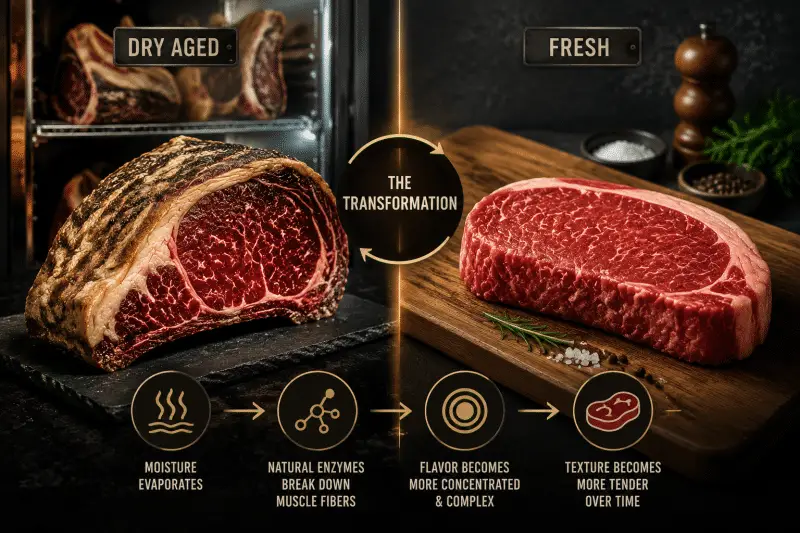
- Moisture slowly evaporates from the meat
- Natural enzymes break down the muscle fibers
- Flavor becomes more concentrated and complex
- Texture becomes more tender over time
If the process is done in the correct conditions and manner, the dry aged beef does not spoil like fresh steak would. Instead, it will gradually undergo a controlled transformation.
However, once the aging process is complete and the meat is exposed for trimming and storage, the clock starts moving again.
At this stage, the dry aged beef behaves more like a highly sensitive perishable product.
How Long Is Dry Aged Steak Good in the Fridge After Aging?
There is no single fixed number of days or hours that can answer this question. However, industry practices over time have provided us a realistic range.
Here is a brief description:
- Trimmed dry aged steak: ~3 to 5 days in standard refrigeration
- Vacuum sealed portions: ~7 to 14 days (depending on conditions)
- Untrimmed primal cuts: can last longer, but require strict controlled storage
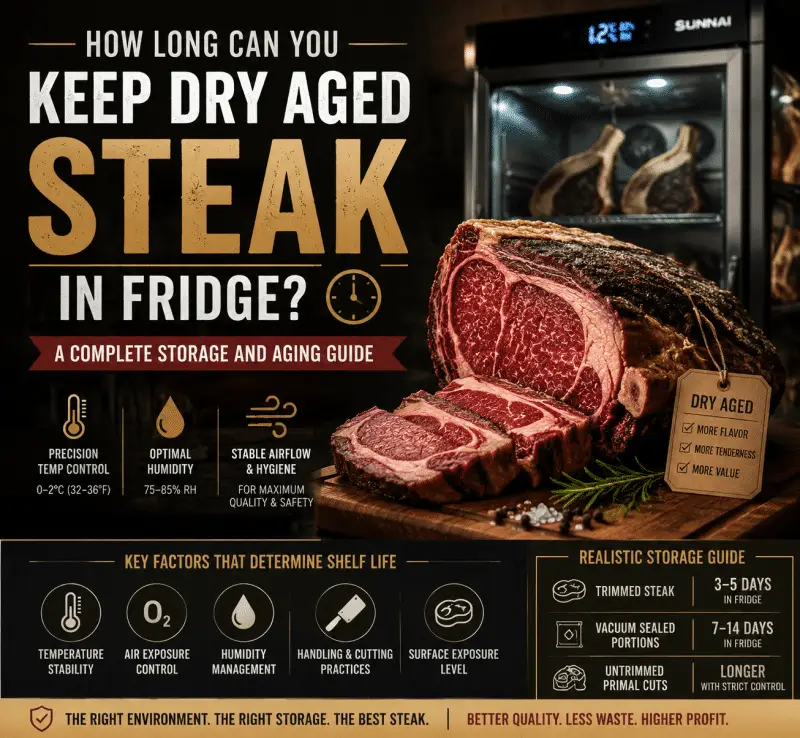
These timelines will only be effective once proper refrigeration at 2–4°C with stable humidity and minimal temperature fluctuation is ensured.
Once a dry aged primal cut is fully aged and trimmed, its storage life becomes much shorter compared to the aging phase itself.
However, in real-world conditions, especially in domestic refrigerators, quality can decline much faster. Why?
Because most standard fridges are not designed for precision meat storage or even aging. Most standard refrigerators would not maintain stable temperatures. They provide uneven cooling zones with fluctuations every time the door opens. There is also a lack of controlled humidity.
So in a normal refrigerator, the quality will start declining after 2–3 days. There will be surface drying and flavor balance may start changing earlier than expected.
This is why professional meat storage is essential. In controlled commercial environments the steak will naturally hold its quality longer and more consistently.
Factors That Influence Shelf Life After Dry Aging
Shelf life after dry aging depends on a few key environmental and handling factors. These include the following:
1. Temperature Stability
A very important factor is that temperature remains constant. The ideal range should be 2–4°C (optimal for premium meat storage).
Even small fluctuations above this range can:
- Increase bacterial activity
- Speed up surface degradation
- Reduce storage window
That’s why industrial refrigeration systems are designed to avoid sudden temperature shifts.
2. Air Exposure and Oxygen Contact
Air is both good and bad in dry aging. During aging, controlled airflow is necessary. But after trimming the excess oxygen exposure becomes a risk factor. Oxidation begins faster and surface quality declines more quickly.
So, vacuum sealing significantly improves stability by reducing oxygen contact.
3. Humidity Control
Humidity plays a quiet but important role. If humidity is too low the meat dries out too fast and the surface hardening occurs. If humidity is too high the microbial growth risk increases and spoilage can happen faster.
Hence the best controlled range in professional systems is 75–85% relative humidity.
4. Handling and Cutting Practices
Every time meat is handled the risk of contamination increases. At the same time, surface integrity can be affected and shelf life may reduce slightly. This is why commercial kitchens follow strict portioning and storage protocols.
Differences in Storage Longevity
Let’s simplify this comparison:
- Whole primal cuts: More stable, slower degradation
- Portion steaks: Faster quality decline due to exposure
The key difference is surface area vs protection level.
The more exposed the meat is, the faster it reacts to environmental conditions.
Surface Exposure and Spoilage Risks
This is one of the most important concepts in meat storage.
After dry aging the surface of the meat is already dehydrated and concentrated. So what happens next depends on exposure. If there is controlled good exposure with stable airflow, clean environment and controlled humidity the result will be slower deterioration and more predictable shelf life.
In uncontrolled risky exposure where there is open air storage, temperature fluctuations and frequent handling the outcome will be faster spoilage, uneven surface breakdown and shorter usable life.
Signs That Dry Aged Steak Is No Longer Suitable for Consumption
Visual Indicators
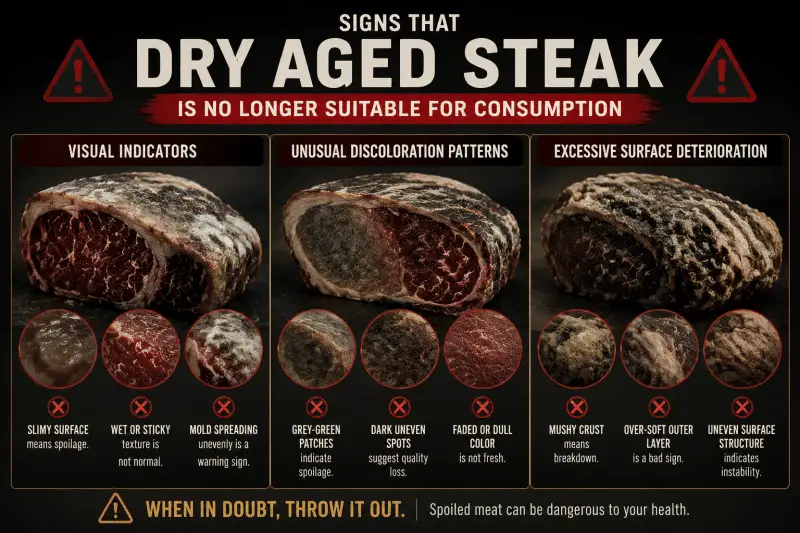
- A slimy surface means spoilage.
- Wet or sticky texture is not normal.
- Mold spreading unevenly is a warning sign.
Unusual Discoloration Patterns
- Grey-green patches indicate spoilage.
- Dark uneven spots suggest quality loss.
- Faded or dull color is not fresh.
Excessive Surface Deterioration
- Mushy crust means breakdown.
- Over-soft outer layers are a bad sign.
- Uneven surface structure indicates instability.
Odor and Texture Changes
- Rotten smell means unsafe meat.
- Ammonia-like odor indicates spoilage.
- Slimy touch means discard immediately.
Normal vs Spoilage Aroma
- Nutty, earthy smell is normal aging.
- Strong sour smell is not normal.
- Chemical or rotten odor means spoilage.
Warning Signs Not to Ignore
- Mold spread beyond surface control.
- Combined bad smell and slimy texture.
- Any strong foul odor means unsafe consumption.
Factors That Affect How Long Dry Aged Steak Lasts in the Fridge
The shelf life of dry aged steak in the fridge is not just about time. It is about environmental control.
1. Temperature Stability and Refrigeration Quality
Temperature consistency is the most important factor in meat preservation. Even small fluctuations can affect microbial growth and moisture stability.
Ideal storage conditions for dry aged steak meat include:
- Temperature: 2–4°C
- No frequent door opening
- Stable internal airflow.
When temperature rises above safe cold storage levels there will be fast spoilage risks.
2. Packaging and Exposure to Air
Air exposure also impacts how long dry aged steak stays fresh.
- Vacuum Sealing Advantage
Vacuum sealing helps:
- Reduce oxidation
- Limit moisture loss
- Slow bacterial exposure
This significantly improves shelf stability compared to open storage.
- Traditional Wrapping
If steak is loosely wrapped or exposed the surface drying increases, flavor deterioration happens faster and there is higher risk of contamination.
In professional meat programs, packaging control is as important as temperature control.
3. Handling Practices After Aging
Even perfect storage conditions can be compromised by poor handling. This means there are risks included like:
- Cross-contamination from surfaces or tools
- Improper portioning techniques
- Frequent temperature disruption during handling
For restaurants and butchers, even small operational mistakes can shorten shelf life significantly.
How Long Can You Dry Age Beef Before Storage Even Becomes an Issue?
Before we even talk about fridge storage, it is important to know the aging duration itself. Because the aging length directly affects how the product behaves afterward.
Short-Term Aging (21–30 Days)
- Mild flavor development
- Tenderness improvement begins
- Lower moisture loss
- More stable post-aging storage
This is often used for entry-level dry aged programs.
Medium-Term Aging (45–60 Days)
- Noticeably deeper flavor
- Increased tenderness
- Higher product differentiation
- Slightly more sensitive post-aging stability
This is the most common range for premium restaurant supply.
Extended Aging (75+ Days)
- Extremely intense flavor profile
- High moisture reduction
- Strong aroma development
- More delicate post-aging storage behavior
Long-aged beef requires stricter handling after removal from aging conditions.
Why Dry Aged Steak Shelf Life Changes After Aging
This is where science becomes important. As beef dries during aging it undergoes certain changes:
- Water activity decreases
- Surface proteins concentrate
- Natural protective barriers form.
However, once removed from controlled aging conditions the protective environment is gone. The exposure to oxygen increases and the temperature stability becomes critical. This transition phase is where most spoilage risks occur.
So, even the smallest variations in refrigeration quality can dramatically change shelf life.
Why Standard Refrigerators Are Not Ideal for Dry Aged Steak Storage
This is one of the most overlooked problems in both home and small commercial kitchens.
Limitations of Standard Refrigerators
As already mentioned above most conventional fridges have:
- Uneven temperature zones
- Poor humidity control
- Limited airflow regulation
- Frequent temperature spikes from door opening
These factors lead to uneven surface drying, faster microbial growth and reduced product consistency. In simple terms: they are designed for general food storage, not precision meat preservation.
How Dry Aging Coolers Improve Shelf Life and Quality
Specialized dry aging systems solve these problems by controlling all environmental variables.
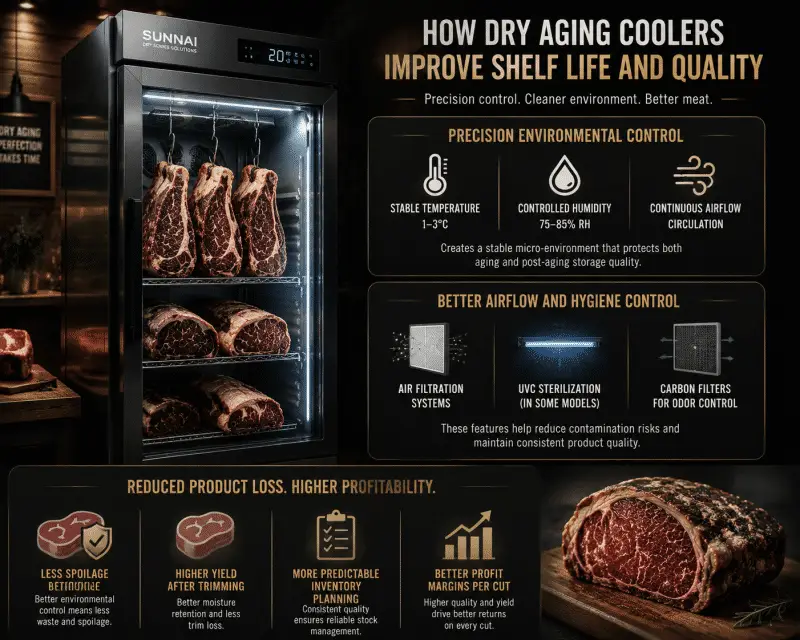
Precision Environmental Control
Professional dry aging coolers offer the following features:
- Stable temperature ranges (typically 2–3°C)
- Controlled humidity (often 75–85%)
- Continuous airflow circulation
This creates a stable micro-environment that protects both aging and post-aging storage quality.
Better Airflow and Hygiene Control
Advanced systems also include:
- Air filtration systems
- UVC sterilization in some models
- Carbon filters for odor control
These features help reduce contamination risks and maintain consistent product quality.
Reduced Product Loss
For commercial users, this is critical.
Better environmental control means:
- Less spoilage
- Higher yield after trimming
- More predictable inventory planning
- Better profit margins per cut
SUNNAI Dry Aging Cooler Solutions for Professional Buyers
For restaurants, butchers, and distributors, storage is not just about preservation. It is about consistency and profitability.
This is where professional-grade systems like SUNNAI dry aging coolers are used in commercial environments.
Premium Features for Dry Aged Meat Storage
These systems are designed for:
- Precision temperature and humidity control
- Stable long-term dry aging performance
- Post-aging storage reliability
- Commercial-scale operation
Manufactured for Commercial Meat Programs
SUNNAI systems are commonly used in:
- High-end restaurants
- Meat distributors
- Specialty butcher shops
- Hospitality kitchens
The focus is not just on aging, but on maintaining product integrity after aging is complete.
OEM and Private Label Capability
For international partners, SUNNAI also offers:
- OEM manufacturing
- Private label customization
- Bulk production capability
- Engineering-based design adaptation
This allows businesses to build their own branded refrigeration and aging solutions while relying on factory-level manufacturing support.
Conclusion: So How Long Can You Keep Dry Aged Steak in the Fridge?
The answer depends on one key factor that is how controlled your storage environment is.
Dry aged steak is a precision product. It is highly sensitive to temperature fluctuations, airflow and handling practices. Even small changes in storage conditions can dramatically affect shelf life and eating quality.
We know that standard refrigerators can provide only a few days of optimal quality. If there is vacuum-sealed storage then the meat can be stored up to ~1–2 weeks in controlled conditions. On the other hand, professional dry aging systems have significantly improved stability and consistency.
For home users, careful refrigeration and proper packaging can help maintain quality for a short period.
However, for commercial operators, investing in professional dry aging and storage systems is essential. It can protect product value, improve condition consistency and boost customer experience.
FAQs
Can dry aged steak go bad in the refrigerator?
Yes. If the temperature rises above safe storage levels or if the meat is exposed to air or contamination occurs due to mishandling, then spoilage can take place quickly.
What temperature should dry aged steak be stored at?
The best storage temperature is between 2–4°C . This is required for optimal safety and quality.
Can I freeze dry aged steak?
Yes. However, freezing can slightly affect texture and moisture structure. So, you should have vacuum sealing before freezing.
Does dry aged steak last longer than fresh steak?
Not necessarily after aging. While aging improves flavor and tenderness, the post-aging storage still follows strict perishable food timelines.
What is the best way to store dry aged steak commercially?
The best method is to store dry aged steak is in controlled refrigeration using dedicated dry aging or precision cooling systems that regulate temperature, humidity and airflow consistently.