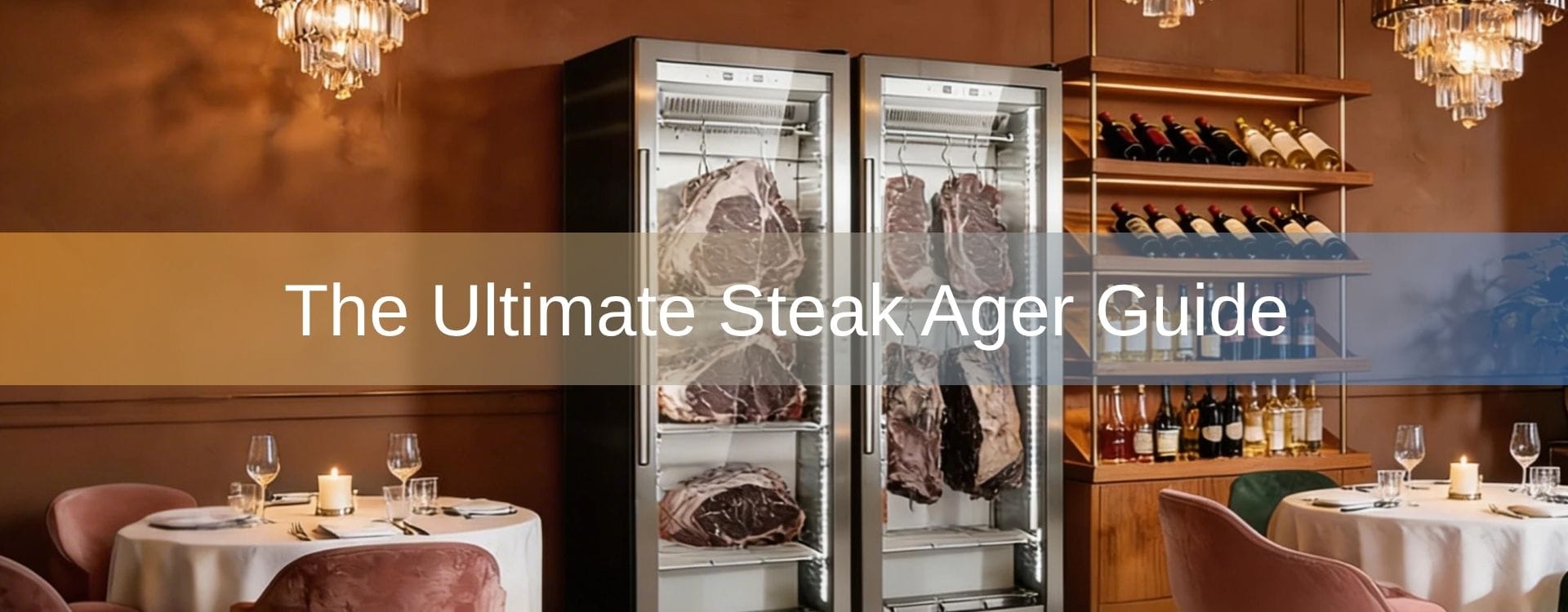
Dry-aged beef was once a specialty. You could only find it in a few traditional steakhouses or at butcher shops run by experts who had mastered the craft.
That has changed. Dry-aged beef appears on restaurant menus everywhere. Butcher shops use it to stand out from the competition. Home cooks are joining the trend too, with some even setting up aging systems in old refrigerators or dedicated units.
The meat doesn’t change; it’s the way you eat it. The problem is the equipment. Modern steak aging systems completely changed a walk-in cooler, a talented hand, and some luck into a controllable, repeatable, and scalable process. It’s this transition that’s responsible for the rapid growth of this category and for the importance of the equipment decision that is often overlooked by buyers.
This guide takes you through the operation of a steak ager, the differences between a good steak ager and a mediocre (or worse) one, and the specific questions commercial buyers should consider when choosing a manufacturer.
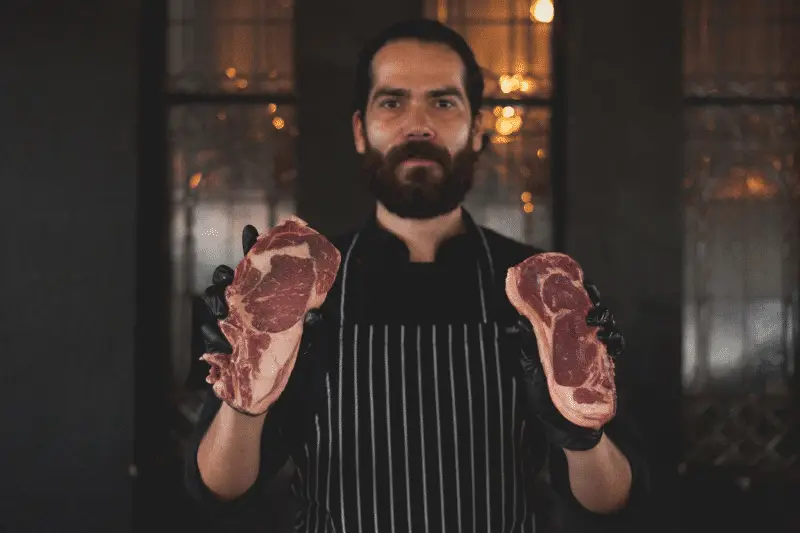
Understanding How a Steak Ager Works
Getting the equipment right starts with understanding what it is actually doing to the meat, because that science determines which features matter and which are just marketing.
The Science Behind Dry-Aging Beef
Dry aging is, at its core, a controlled dehydration process. The beef sits in a temperature and humidity-controlled environment for an extended period, and moisture slowly leaves the muscle tissue. As that moisture evaporates, the remaining flavor compounds concentrate. That is the entire mechanism behind why dry-aged beef tastes the way it does. Nothing mystical about it. Just controlled science.
Aging duration shapes the result directly:
- 21 to 28 days — Subtle flavor shift, noticeably more tender than fresh beef, mild nuttiness beginning to develop
- 30 to 45 days — Deeper, more complex flavor profile with pronounced umami notes and a firmer pellicle forming on the surface
- 45 to 90+ days — Intense, concentrated flavor with cheese-like characteristics that serious dry-age enthusiasts specifically seek out
The second mechanism running alongside moisture loss is enzymatic tenderization. Natural enzymes already present in the meat break down muscle fibers and connective tissue over the aging period.
Environmental Conditions Required for Successful Aging
This is where equipment quality stops being a nice-to-have and becomes the entire point. Three variables govern every successful dry aging cycle:
Temperature control has to stay stable. Dry aging happens in a narrow temperature band, and any meaningful fluctuation creates real risk. Too warm, even briefly, and you are looking at spoilage risk and bacterial growth. Too cold, and the aging process slows or stalls. A unit that cannot hold a consistent temperature across a multi-week aging cycle is not a serious option for anyone aging product commercially.
Humidity management works alongside temperature as the second critical variable. The consequences of getting this wrong fall into two categories:
| Humidity Too Low | Humidity Too High |
| Excessive surface drying | Spoilage risk increases |
| Higher trim loss per cut | Inconsistent crust formation |
| Tougher pellicle, harder to remove | Mold growth on the meat surface |
| Reduced yield, higher cost per pound | Product quality variance batch to batch |
Air circulation rounds out the trio. Airflow is what actually drives moisture evaporation from the meat’s surface. Without proper circulation, you get uneven aging where parts of a cut age properly and other parts barely change at all. A well-designed steak ager moves air consistently across every shelf and every cut, not just the pieces sitting closest to the fan.

Different Types of Steak Ager Systems
The right unit depends entirely on your volume, your operation type, and how seriously you intend to compete in the premium beef market. The category splits cleanly into two tiers.
Compact aging units suit enthusiasts and small-volume operators. These offer:
- Lower capacity, typically holding 2 to 6 cuts at once
- Simplified environmental controls with basic temperature and humidity settings
- Smaller footprint suitable for home kitchens or tight retail floor space
- Lower upfront investment for buyers testing the dry aging category
Professional dry-aging cabinets are built for larger cuts and serious commercial volume. These come with:
- Significantly more sophisticated environmental control systems
- Larger capacity accommodating full primals and multiple simultaneous cuts
- Commercial-grade build quality that holds up under continuous daily operation
- Advanced monitoring, data logging, and, in many cases, remote management capability
If you are running a restaurant, butcher shop, or specialty retail operation, the professional cabinet tier is what you actually need to evaluate. Compact units are not engineered for the continuous demands of commercial production.
You can explore Sunnai’s full range of dry-age fridges across both tiers to understand the available configurations before making a decision.
Key Features to Look for When Buying a Steak Ager
Not every spec on a product listing matters equally. These are the features that directly affect product quality, food safety, and operational economics.
Precision Climate Control Systems
Temperature accuracy is a food safety requirement, not a luxury feature. A unit that drifts even a couple of degrees outside its target range during a multi-week aging cycle puts the product at risk every time it does so. The key questions to ask any manufacturer:
- What is the temperature variance tolerance across the full operating range?
- How does the unit perform during ambient temperature fluctuations in the room?
- Does the controller alert operators when the temperature moves outside acceptable parameters?
- How quickly does the unit recover to the target temperature after the door is opened?
Humidity regulation matters just as much. Every percentage point of unnecessary trim loss on a dry-aged cut is real money walking out the door. A unit that holds humidity within a tight operational range pays for itself over time in reduced waste alone.
Capacity and Storage Configuration
Matching capacity to actual operational needs may sound obvious, but it is where many buyers get it wrong. The most common mistakes:
- Buying for current volume only — Growth means replacing equipment within 18 months instead of getting a decade of use from the unit
- Ignoring shelf configuration flexibility — Different cuts have different shapes, and a unit that only accommodates one configuration limits what you can age
- Underestimating hanging capacity — Whole primals and sub-primals often need hanging rather than shelf storage, and not all units support this
A quick capacity planning table for common commercial operations:
| Operation Type | Recommended Minimum Capacity | Preferred Configuration |
| Home enthusiast | 2 to 4 cuts | Compact, shelved unit |
| Specialty butcher shop | 8 to 20 cuts | Mid-size cabinet with flexible shelving |
| Independent restaurant | 15 to 30 cuts | Professional cabinet with hanging option |
| Multi-location group | 30+ cuts per location | Commercial-grade units, scalable |
Hygiene and Food Safety Design
Easy-to-clean interiors are non-negotiable in a commercial setting. The features that make a real difference in daily operations include:
- Stainless steel or food-safe coated interiors that do not absorb odors or bacteria over time
- Removable shelf and rail systems that can be fully disassembled for deep cleaning
- Sealed corners and edges that eliminate the gaps where debris accumulates
- UV sterilization systems that actively manage airborne bacteria and mold spores during aging cycles
- HEPA or activated carbon filtration that cleans the air circulating the exposed product
These features look unglamorous on a spec sheet but matter enormously in daily real-world use and in any compliance inspection scenario.
Sunnai’s manufacturing process applies rigorous quality control standards across every unit, including materials testing and food-contact safety verification before products ship.
Why Is a Dry-Aged Cooler a High-ROI Investment?
Commercial operators often treat dry aging equipment as a cost. It is more accurately understood as a revenue-generating asset. Here is where the return actually comes from.
Creating Premium Product Value
Dry-aged beef commands significantly higher market prices than standard fresh beef across nearly every channel it is sold through. The economics look like this:
- Premium pricing on dry-aged cuts typically runs 25% to 50% above equivalent fresh cuts at retail
- Restaurant menus featuring dry-aged selections can command 30% to 80% price premiums depending on aging duration and cut
- Glass-door display units function simultaneously as aging equipment and retail merchandising, reinforcing premium positioning directly on the floor.
The unique flavor profile dry aging produces also gives a business a genuine differentiator in a crowded market. That differentiation supports brand positioning that extends well beyond any individual product.
Consistent Aging Performance Reduces Waste
Precision environmental control produces two compounding financial benefits:
- Reduced spoilage risk — Stable temperature, humidity, and airflow conditions mean fewer batches lost to bacterial growth or inconsistent crust development
- Predictable trim loss — When humidity holds consistently, operators can plan yield accurately and price accordingly, rather than absorbing variable losses batch to batch
That predictability supports better inventory planning and more reliable quality assurance than improvised aging methods, which are still surprisingly common among operators who have not invested in proper equipment.
Lower Long-Term Operating Costs
Energy-efficient refrigeration systems designed for continuous operation keep utility costs manageable across the equipment’s full lifecycle. Beyond energy, the cost picture includes:
- Integrated monitoring systems that simplify daily management and reduce staff time spent on manual checks
- Durable commercial construction that minimizes downtime and repair frequency
- Mid-cycle failure protection — A unit that breaks down during an aging cycle does not just cost a repair bill. It can cost an entire batch of product plus the time already invested in that aging run.
Supporting Business Growth
Scalable capacity allows expanding operations to increase production volume without compromising aging quality. For distributors and brands building their own product line, Sunnai’s OEM and ODM services provide custom branding, product development support, and flexible manufacturing configurations across different market segments.
Why Commercial Buyers Prefer Professional Dry-Aged Coolers
Commercial operators consistently choose professional-grade units over compact systems, and the reasons are consistent across operation types. Here is what drives that preference in practice.
The operational advantages of professional-grade units:
- Real-time environmental monitoring with alerts when conditions move outside acceptable ranges
- Data logging capability that supports quality assurance documentation and compliance traceability
- Higher weight capacity accommodating full primals rather than pre-cut portions only
- Commercial compressor systems are rated for continuous duty cycles rather than intermittent home-use operation
- Remote management options on higher-end units allow temperature and humidity checks without physically entering the storage area.
The return on investment case is straightforward for serious operators. Increased revenue from premium beef products, combined with a long service life and dependable performance, contributes directly to long-term profitability. Buyers running real volume are not just purchasing a cooler. They are purchasing years of consistent, predictable production.

Choosing a Reliable Dry-Aged Cooler Manufacturer
Specs on a sheet only tell part of the story. Manufacturing consistency matters just as much, since a unit that performs well in a sample but varies across a production run creates real problems for distributors and retailers managing multiple locations.
SUNNAI Dry Aged Cooler Solutions for Global Brands
Sunnai has been manufacturing compression refrigeration products since 2010, with dry-age refrigerators engineered specifically for premium meat aging. Precision temperature, humidity, and airflow management sit at the center of every unit.
Key manufacturing credentials:
- 15 years of production experience in compression refrigeration equipment
- German-supervised manufacturing with a welding engineer team from German overseeing production, resulting in a leakage failure rate below 0.1%
- Three testing laboratories — an aging lab, a comprehensive lab, and a power supply version testing lab — are running independent verification on every production batch
- 8 production lines producing more than 150,000 units per year
- Certifications covering CE, CB, GS, NRTL, RCM, RoHS, REACH, and CCC for access to major international markets
For buyers who want to evaluate manufacturing processes before committing, Sunnai’s quality control documentation and full certification list are available for review. Sunnai also works with major retail partners, including Amazon, Costco, Walmart, and Metro, which reflects the production consistency required to supply at that scale.
Brands looking to build their own product line can explore partnership and cooperative opportunities that go beyond standard OEM arrangements.
Future Trends in Dry Aging Equipment
The dry aging equipment category is evolving in two clear directions, and commercial buyers planning multi-year investments should factor both into their decisions.
Smart monitoring and remote management are becoming standard rather than premium add-ons. Current developments include:
- IoT-connected units that log temperature, humidity, and airflow data continuously
- Remote monitoring apps that allow operators to check aging conditions from any location
- Automated alerts when environmental parameters drift outside acceptable ranges
- Data export capabilities that support HACCP documentation and quality assurance record-keeping
Conclusion
A successful steak ager investment depends on more than capacity alone. Temperature control, humidity management, airflow, and hygiene all carry equal weight, and a unit that excels in one area while neglecting another will eventually show it in product quality or operational problems.
The comparison between compact units and professional dry aged coolers comes down to actual business objectives and production requirements, not upfront price.
Sunnai’s professional dry aged cooler solutions bring the precision, reliability, and customization support that today’s premium dry-aging market demands. Get in touch to discuss your specific production requirements.
FAQ
What is a steak ager and how does it work?
A steak ager is a refrigeration unit built specifically for dry aging beef. It controls temperature, humidity, and airflow precisely over weeks at a time, concentrating flavor and tenderizing meat in a way a standard refrigerator simply cannot replicate.
How long should beef be dry-aged for the best flavor?
Most operators age beef between 21 and 45 days. Shorter runs produce subtle tenderization and mild flavor shifts. Longer runs past 45 days develop the deeper, nuttier notes serious buyers look for. The right duration depends on your target flavor profile and acceptable trim loss.
Is a steak ager worth the investment for home users?
For enthusiasts who age beef regularly, yes. Standard refrigerators cycle humidity and temperature too broadly for reliable results. A dedicated unit holds conditions stable across the full aging period, which means better consistency and far less spoilage risk.
What temperature should a steak ager maintain?
Between 34 and 38 degrees Fahrenheit (1 to 3 degrees Celsius), held consistently throughout the aging cycle. Drifting warmer creates spoilage risk. Dropping below freezing stalls the enzymatic processes that drive tenderization and flavor development.
What humidity level is ideal for dry-aging beef?
75 to 85 percent relative humidity. Below that range, the cut dries too aggressively, and trim loss increases. Above it, excess moisture invites mold growth and inconsistent crust formation.