Outdoor Ice Maker vs. Freezer Drawer: Which Does Your Outdoor Bar Really Need?
Nothing kills an outdoor bar faster than the “ice run.” Someone disappears inside, comes back ten minutes later with a half-melted bag, and now your margaritas taste like pool water.
Here’s the fix: stop treating “cold stuff” like one problem. An outdoor ice maker and a freezer drawer solve two different bottlenecks, even though both live under your counter and both hum like they own the place.
So the real question isn’t which category is better. It’s whether your project needs continuous ice production, flexible frozen storage, or a combo that doesn’t eat up half your cabinet run. Serving volume, menu, cabinet width, utilities, and outdoor exposure decide this—not vibes.
Outdoor Ice Maker vs. Freezer Drawer: Start With What the Bar Needs to Do
1. Choose an Outdoor Ice Maker When Ice Is Part of the Service Workflow
Continuous Ice Production for Drinks
If you’re actually making drinks—cocktails, spritzes, shaken stuff, crushed-ice stuff—ice is an ingredient, not a garnish. A dedicated ice maker keeps producing and refilling its bin. You’re not playing catch-up with trays, or praying the freezer’s little ice kit didn’t jam again.
When selecting an undercounter ice maker, evaluate both daily ice production and usable ice-storage capacity. Production determines how quickly ice is replenished, while storage determines how much you’ve got on hand when peak demand hits and three people decide they “also want one of those.”
Think About Ice Type, Not Just Ice Quantity
People get hung up on “pounds per day” and forget the ice format changes the drink.
- Full cubes / clear-style cubes: slower melt, better for spirits and cocktails you don’t want diluted in 90 seconds.
- Nugget / chewable ice: great for patio sodas, tiki drinks, kid chaos—melts faster, eats bin volume.
- Crescent / half-moon: common, efficient, perfectly fine for mixed use.
The trap: buying “a lot of the wrong ice.” It still disappears during peak service—just with worse drinks.
2. Choose a Freezer Drawer When Storage Flexibility Matters More
Frozen Ingredients and Bar Supplies
If your outdoor setup doubles as a cooking station, ice is only one line item. You also need somewhere for:
- frozen fruit, sorbet, gel packs for chilling wine buckets
- backup burger buns, shrimp, steaks, or “oh no the guests brought more food” storage
- glassware you like serving frosty (yes, it’s a thing)
Drawer format helps because you can organize by “grab speed.” Top layer: frequent items. Bottom: backup. No knee-on-the-deck digging through an upright cavity.
Better for Bars With Mixed Food-and-Beverage Functions
A drink-only station usually prioritizes ice and beverages. A full outdoor kitchen has competing demands: prep ingredients, protein, desserts, kids’ stuff, party overflow. In those builds, freezer space stops being a luxury and starts being the only way the workflow doesn’t collapse at 7:30 pm.
The Key Difference: Production Capacity vs. Storage Capacity
Ask one blunt question: what runs out first on a busy day?
- If it’s ice, you want production.
- If it’s space, you want storage.
And don’t confuse normal use with event use. Daily family mode might be relaxed. Then you host twelve people and suddenly you’re rationing ice like it’s wartime.
Ice Maker Buying Guide Factors That Matter More Outdoors
Water Supply and Drainage Can Decide Whether an Ice Maker Is Practical
Dedicated Water Connection
Many undercounter ice makers expect a permanent water feed. That’s not a “nice to have.” That’s the machine’s whole deal.
And no—running a 25-foot line as an afterthought isn’t “close enough.” Long runs, bad routing, and lazy shutoff placement are how you end up with service calls that could’ve been avoided during cabinetry design.
Drainage for Meltwater
Ice makers don’t just “make ice.” They also deal with meltwater and purge water. Depending on the design, you may need a gravity drain path or a drain pump solution.
Plan drain routing while you’re still designing cabinetry—doing it after install is how people end up with a kinked hose, standing water, and a unit that “mysteriously” underperforms.
Outdoor Conditions Change the Appliance Requirements
Heat, Moisture and Splash Exposure
Outdoor installs live in a messier world: wind-driven rain, hose spray, pool splash, humidity spikes, heat reflecting off stone. If you’re buying “outdoor,” look for a unit designed for that environment—not an indoor model with a stainless face and false confidence.
SUNNAI’s outdoor refrigeration line is positioned around weather exposure and protection features like IPX4 waterproof ratings, with operating claims intended for demanding outdoor installs.
Quick reality check: IPX4 isn’t “pressure-washer me.” It’s “normal splash and outdoor mess shouldn’t end me.”
Ventilation Must Match the Cabinet Design
Built-in bars fail when airflow is treated like an afterthought. Block the intake/exhaust and you raise internal temps, extend run time, and shorten the unit’s life.
Front ventilation helps because it matches how outdoor islands are actually built—tight, finished, and not interested in giving your appliance extra breathing room just because the manual politely asked.
Compare the Total Installation Footprint
One appliance is simple. Two appliances are capacity. The “right” answer depends on cabinet width, plumbing access, and budget.
- Ice maker + freezer drawer: strong dedicated performance, bigger footprint.
- Combo unit: fewer cutouts, fewer utility runs, easier layout in tight builds.
Compact bars (BBQ islands, patios, yachts) often don’t have room for two specialty boxes—so multifunction units start making sense.
Which Setup Fits Different Outdoor Bar Scenarios?
Cocktail-Focused Outdoor Bar
Ice demand comes first. If the menu is cocktail-heavy, you don’t want staff (or your guests) walking inside for ice all night.
And here’s the part people ignore: once your ice is inside, you start compromising—smaller drinks, more dilution, warm glassware, rushing builds. A dedicated ice maker keeps the station honest.
Freezer Space May Be Secondary
For a cocktail-first station, freezer needs might be small: frozen fruit, maybe a few backup items. In those layouts, pairing a real ice solution with dedicated beverage storage is usually cleaner than stuffing everything into one overworked cavity.
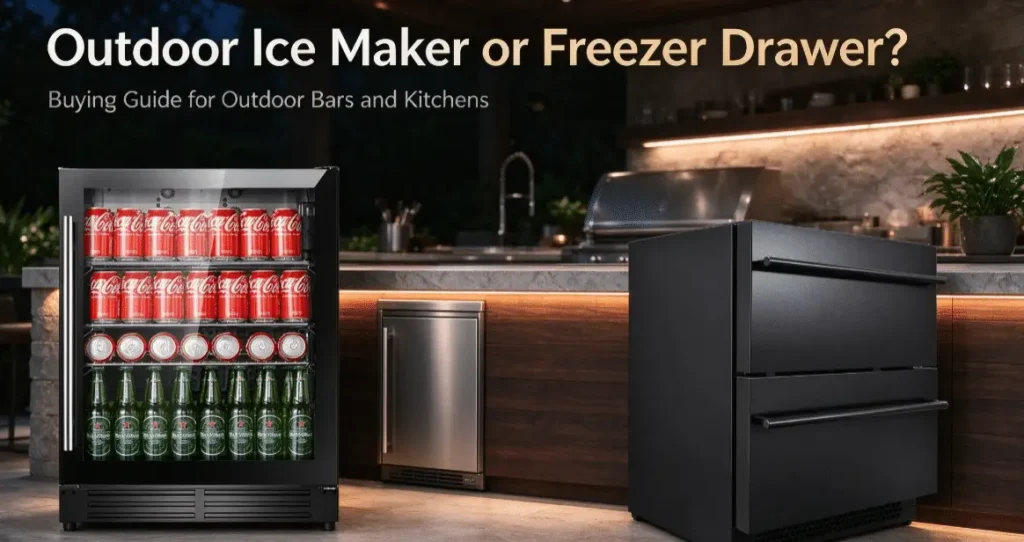
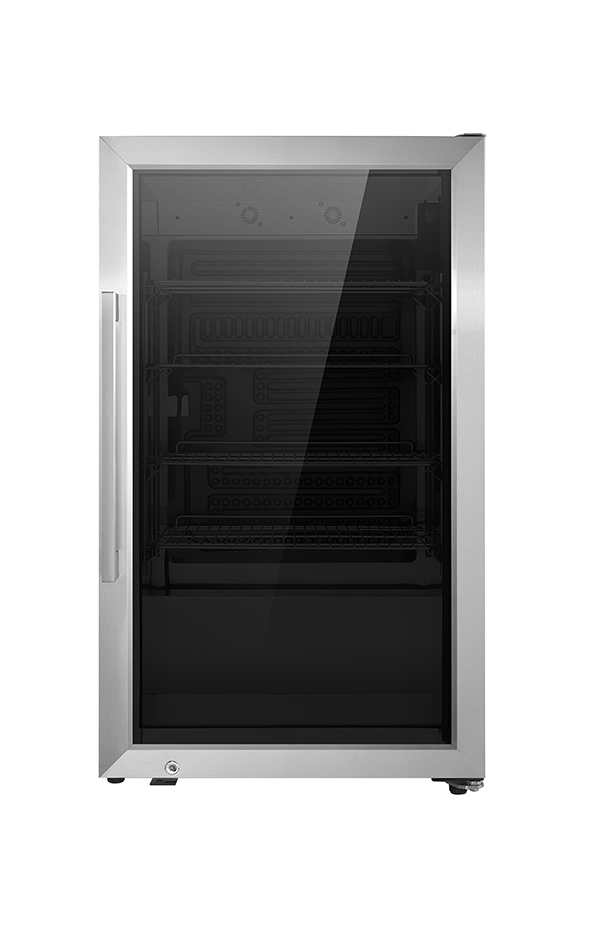
If you’re building out a full bar line, SUNNAI’s SY-51 Outdoor Beverage Cooler is the kind of “quiet workhorse” you spec to keep cans and mixers parked at serving temp (150L / 132 cans listed capacity, 3–16°C range).

Outdoor Kitchen and BBQ Island
Storage becomes the daily pain point. Food prep expands cold needs fast—protein, sauces, frozen backup, desserts. A freezer drawer supports the cooking workflow because it’s quick access beneath the counter, and it doesn’t care whether you’re making Negronis or feeding four hungry kids.
Poolside, Yacht and Hospitality Projects
Space efficiency matters. Also reliability. Also service access. Also the fact that nobody wants a tech tearing apart finished millwork because the designer left zero clearance.
For these builds, you spec around: outdoor suitability, front-vented built-in design, corrosion-aware materials, and whether the supplier can keep model consistency across multiple units.
Do You Really Have to Choose? Combining Ice Making and Outdoor Refrigeration
SUNNAI Outdoor Freezer Drawer With Ice-Making Function for Integrated Projects
Some projects need both functions, but don’t have the cabinet run—or the patience—for two boxes. That’s exactly where an integrated drawer platform makes sense.
A concrete example: the SUNNAI SY-60 Outdoor Freezer Drawer With Ice-Making Function uses a two-drawer layout with an ice-making drawer on top, plus additional cold storage below, in a built-in format with front ventilation and IPX4-rated construction.
Now the part that needs to be said clearly (because people love reading spec tables like horoscopes):
- The SY-60 is a single-temperature, two-drawer design.
- The upper drawer incorporates the ice maker, and the lower drawer is extra storage space.
- Both drawers share the same temperature setting and cannot be controlled independently.
- During ice-making operation, that lower drawer behaves as frozen storage, not a separate “refrigerator compartment.”
So if your project brief says “ice + chilled beverages in one box,” no—this isn’t that. Pair the SY-60 with a beverage cooler (like the SY-51) and move on with your life.
Specs buyers actually use in planning (not marketing fluff): the SY-60 is listed at 60L gross volume, R600a refrigerant, a stated temperature range of -20°C to +14°C, and body size W595 × D550 × H820 mm (23.42″ × 21.65″ × 32.28″).
And right after that cabinet-size line—because ice output is what decides whether this fits your service: the upper drawer uses a crescent-shaped ice maker with a rated output of 2.2 kg per 24 hours. Compare that number to your expected daily ice demand and your peak serving moments (the “two-hour window” is where most outdoor bars get exposed).
One more honest note from the field: real-world ice output is always at the mercy of ambient heat, warm product loads, and how often that drawer gets opened. Outdoor patios aren’t lab conditions. Not even close.
B2B Applications and Customization
For outdoor kitchen brands, appliance distributors, hospitality builds, BBQ island programs, yachts, and residential development packages, the SY-60 pitch isn’t “look, ice.” It’s: fewer SKUs to design around, fewer holes to cut, fewer coordination failures between trades.
SUNNAI positions its outdoor refrigeration business around OEM/ODM project support and a broader outdoor lineup (drawers, kegerators, larger cabinets) built around outdoor-use claims like IPX4-rated product families.
Conclusion: Choose the Appliance Around the Bar Workflow
Pick a dedicated outdoor ice maker when ice is the ingredient and you need steady replenishment.
Pick a freezer drawer when storage is the bottleneck—food, frozen ingredients, overflow, prep support.
And when you need both but cabinet space is tight, an integrated drawer platform like the SY-60 can reduce appliance count—just don’t pretend it’s two independently controlled zones, because it’s not.
FAQ
Does an outdoor ice maker need a water line and drain?
Most undercounter-style ice makers are built around a dedicated water supply, and many installs also plan for drainage (gravity drain or pump approach depending on layout). Treat water + drain as part of the appliance decision, not a “later” item.
Can an undercounter ice maker be installed outdoors?
Only if it’s designed and rated for outdoor exposure. “Stainless front” doesn’t prove anything—look for stated outdoor design intent, protection against splash/moisture, and install guidance that matches real weather.
Is a freezer drawer better than an ice maker for a BBQ island?
If the island supports cooking and prep, freezer (or deep-chill) storage usually creates more daily value than pure ice production. If you’re running cocktails for groups every weekend, flip that logic. Workflow wins.
Can one outdoor appliance provide both ice making and refrigerated storage?
One appliance can cover ice making + extra cold storage, yes. The SUNNAI SY-60 is an example: ice-making in the upper drawer with additional storage below—but both drawers share the same temperature setting, so it’s not “freezer + refrigerator” in one.
Projects that require ice making alongside chilled beverage storage should pair the SY-60 with a dedicated beverage refrigerator like the SY-51.
What should B2B buyers look for when choosing outdoor refrigeration for a bar or hospitality project?
Proof of outdoor suitability (construction details, protection claims), install method (front-vented built-in vs freestanding), service access, and whether the supplier can support OEM/ODM consistency across programs—not just a nice-looking spec sheet.