For the 140th Canton Fair, SUNNAI prepared a refrigeration lineup around outdoor kitchen use and indoor wine storage for warm climates, with cabinet formats selected to give appliance brands and project suppliers several starting points for product discussions.
Phase 1 ran from October 15 to 19, 2026, at the China Import and Export Fair Complex in Guangzhou. Our invitation listed Hall 4.1, Booth M17. The theme was “Hot Climate / Outdoor Refrigerator.”
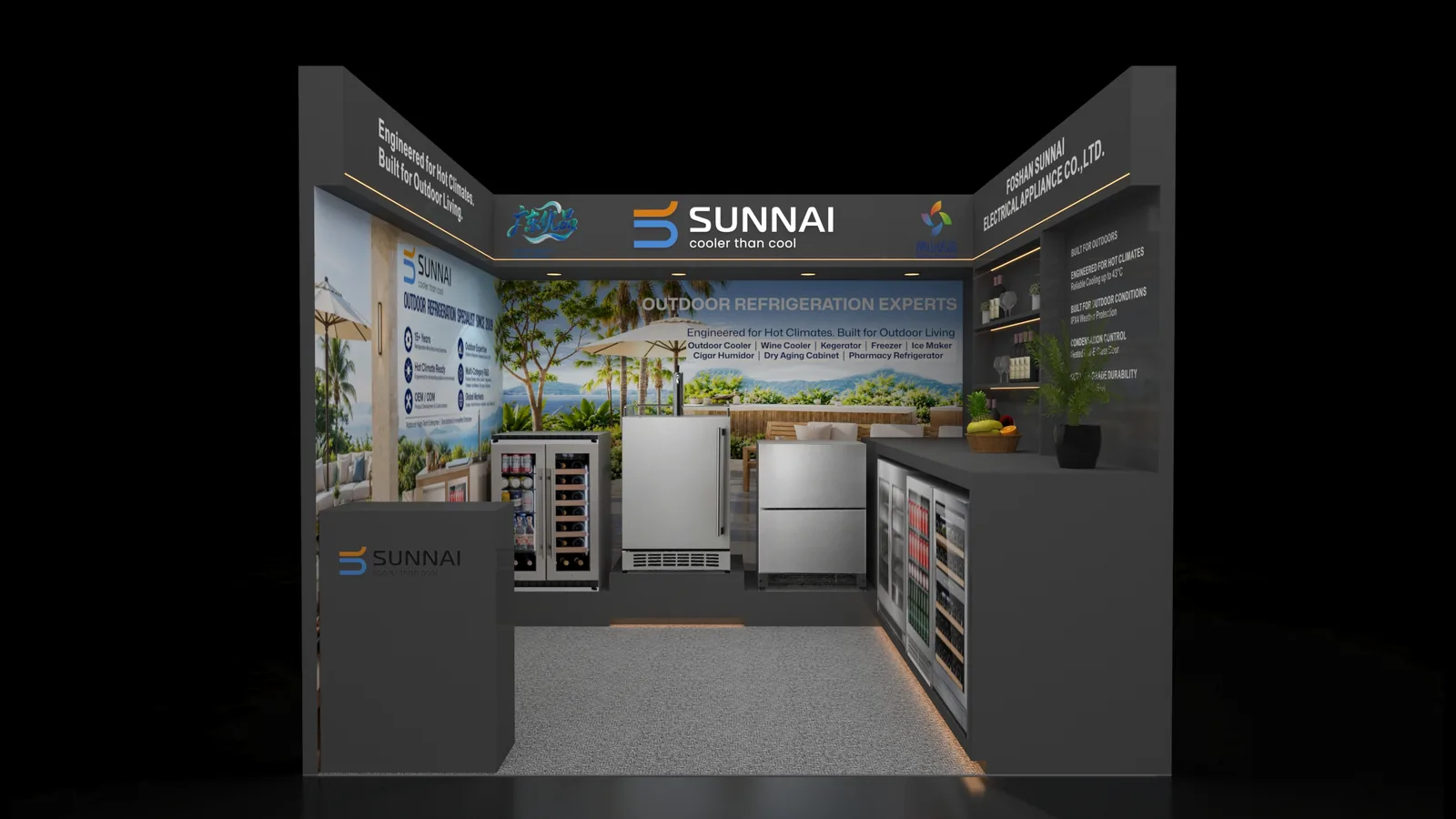
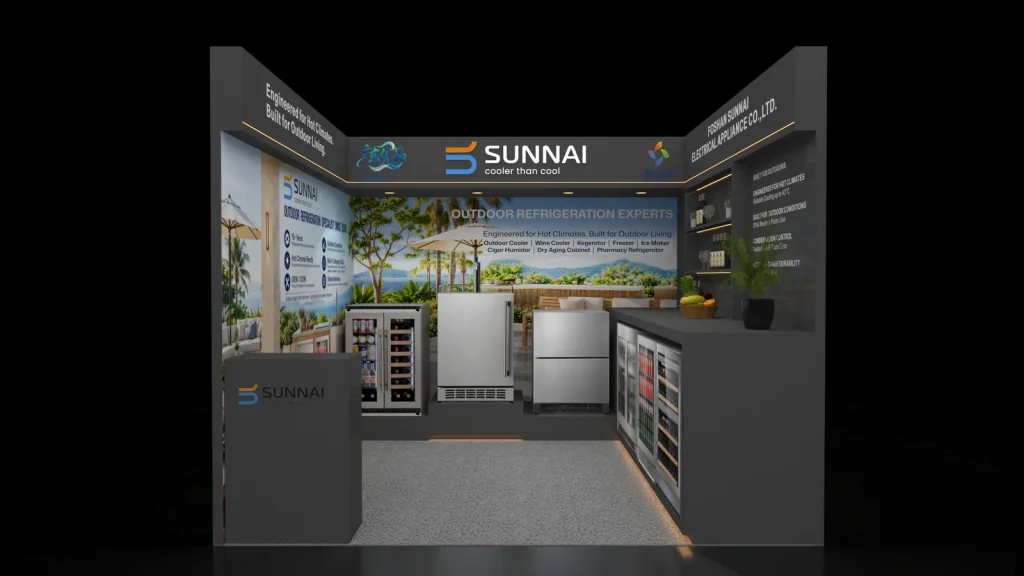
The booth design placed refrigeration within an outdoor kitchen setting, with a serving counter and several cabinet formats shown together. That arrangement gave the presentation a practical reference for product discussions. A buyer could consider how an appliance would sit within a larger kitchen or bar layout, then follow the relevant model through to its dimensions, storage arrangement and available customization.
Outdoor Kitchen Appliances in the Lineup
The product brief covered the SY-60 drawer unit, SY-163 kegerator, SY-188 French-door refrigerator and SY-51 beverage cooler, bringing different ways of storing and serving drinks into the same outdoor kitchen program.
The SY-60 pairs an ice-making drawer with refrigerated storage below. Both functions share one cabinet. For the event presentation, that layout connected ice supply with the preparation space beside a grill or outdoor bar.
Its drawer format also introduced a different access arrangement from the hinged-door models in the brief. For a compact outdoor kitchen, that makes the position of the appliance and the space in front of it part of the discussion. The required ice supply and refrigerated storage should be considered together when deciding how the preparation area will be used.
Draft beer was represented by the SY-163, which can also be configured for packaged beverages when its keg equipment is set aside and the removable shelves are fitted. That gives a project supplier a second use for the same cabinet as the planned beverage service changes.
The SY-188 covered larger-volume storage through its French-door layout, while the SY-51 provided a single-door beverage option for freestanding or integrated placement. The latter has a stated 150-liter gross capacity.
The SY-188 is 900 mm wide. Its format gives project suppliers a larger single appliance to consider where the layout might otherwise call for adjacent undercounter units. The SY-51 has one temperature zone. It adds a simpler beverage-storage format to the lineup, with the choice between the two depending on the opening, the drinks being stored and the surrounding cabinetry.
Wine Storage for Warm Climates
The SW-40 wine cooler was identified separately for the hot-climate part of the brief. It is an indoor model. The distinction matters when a distributor is assembling a range for a warm region, where a wine cabinet inside a restaurant and a refrigerator beside an exposed outdoor counter face different installation conditions.
The SW-40 has a stated capacity of 40 bottles, dual temperature zones and front ventilation for freestanding or under-counter placement. Its triple-layer insulated glass door is designed to reduce heat transfer and condensation, with the required operating conditions to be checked against the intended location.
Warm-climate suitability concerns the operating environment. Outdoor use also calls for a model-specific assessment of weather exposure, construction and placement, so our wine-cooler and outdoor product discussions begin with the location where the appliance will be installed.
The installation location comes first. A wine cabinet inside an air-conditioned restaurant, a unit under an enclosed terrace counter and an appliance near an outdoor cooking area can face different ambient conditions even within the same region. For an OEM order, the expected room temperature and ventilation path should be discussed alongside the wine-storage settings. Those settings describe conditions inside the cabinet.
The SW-40’s dual zones allow the storage requirements for different wines to be discussed within one cabinet. The two zones are separate. Bottle shape and shelf layout also need attention, particularly where the intended stock includes a mix of formats. These are details that a distributor can bring into sample evaluation before committing to a configuration for its market.
Continuing the Product Discussion
Brands and project suppliers can use the lineup as a starting point for OEM and ODM inquiries, then work through cabinet dimensions and local electrical requirements before deciding which configurations to sample.
Our customization discussion can cover the visible details, such as door finishes and handles, together with interior layouts, controls and branding. Packaging and manuals need to follow the configuration selected for the order. Where the request involves a different cabinet size or cooling requirement, the next step is an engineering review to establish what needs to change and how a prototype should be evaluated.
A useful inquiry includes the destination market, expected ambient conditions and a drawing of the installation space. For a wine cabinet, add the bottle formats and required storage temperatures. For draft service, include the keg format and dispensing arrangement so our team can review the appropriate cabinet and equipment configuration.