Are you a small restaurant or café owner wanting to add a few dry aged steaks to your menu? Well, this sounds like a great idea. But when you start to expedite this plan, it may not be as simple as it sounds. Many questions may pop up. Like how many steaks you plan to sell? How much meat can you age at once? Will the dry aging cabinet fit in your kitchen?
And is it worth paying more for a larger model? These are the questions that make choosing a dry aging cabinet capacity tricky.
For first timers and beginners the choice is mostly simple. The larger 125L cabinet is a better choice. Why? Because it holds meat. But does being bigger mean it is better? Well, the answer is no and yes. For a small café serving a few dry-aged cuts each week, it may be more than the requirement. For a busy steakhouse or butcher shop the larger one will be best suited.So, how to choose dry aging cabinet capacity for your business? Let us have some clarity by comparing two models by 순나이, the SUNNAI SN-75 and SN-125.
What Does 75L vs. 125L Mean for Dry Aging Capacity
Compare Cabinet Volume With Real Meat Holding Capacity
Here is the first thing you need to understand. The cabinet volume and meat capacity are two different things.
We know that 125L dry aging cabinet has more internal space. That however does not mean it will hold twice as much meat in it. How much you can actually load in a dry aging cabinet depends on various factors like:
- Size of your cuts
- Shelf arrangements
- Space needed for airflow.
All these impact aging process for the meat.
75L Does Not Mean Small
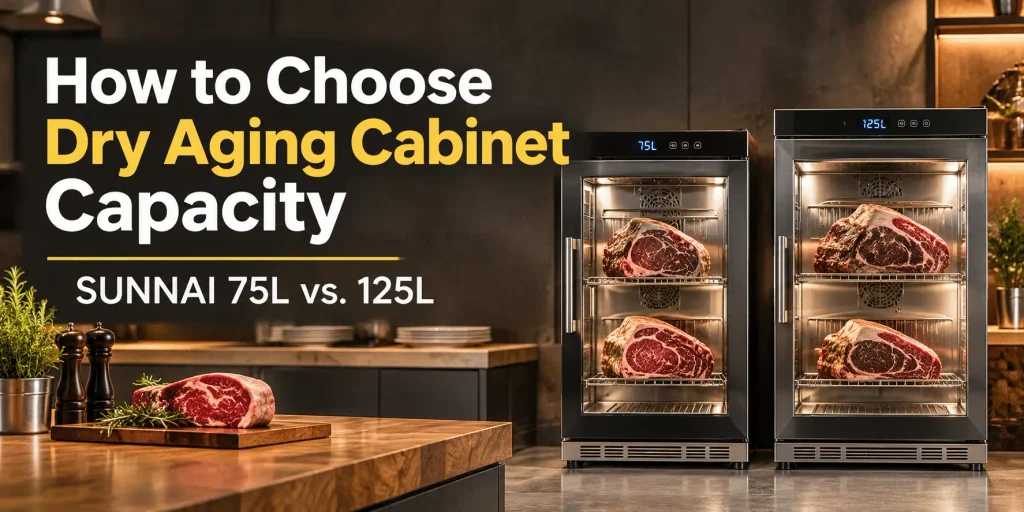
The SUNNAI SN-75 has a 75L capacity. It is rated to hold approximately 20–23 kg (44–50 lb) of meat.
That is a useful amount for a smaller dry aging process. Take the example of a neighborhood steakhouse. It may be offering a few premium cuts only. Or may be a butcher shop that is aging selected beef for customers who specifically ask for it.
You do not always need a large cabinet to get started.
125L Adds Working Flexibility Not Just Liters
The SUNNAI SN-125 offers 125L of space. It has a meat capacity of approximately 20–30 kg (44–66 lb).
The extra room gives you more flexibility. Arranging different cuts or managing several pieces in one batch becomes easier.
But you must remember that SN-125 does not automatically hold dramatically more meat in every setup. Its main advantage is the additional space and arrangement flexibility.
Do Not Estimate Meat Output From Liters Alone
Imagine placing several small beef cuts inside a cabinet. Now imagine loading one large bone-in rib section.
The weight may be similar. However, the space required is very different.
You need room around the meat for air to circulate. If you fill every shelf tightly to reach the maximum weight, that will work against the purpose of controlled aging.
So, you must always compare the recommended meat load and actual arrangement for your cuts. You should not just rely on the cabinet’s liter rating.
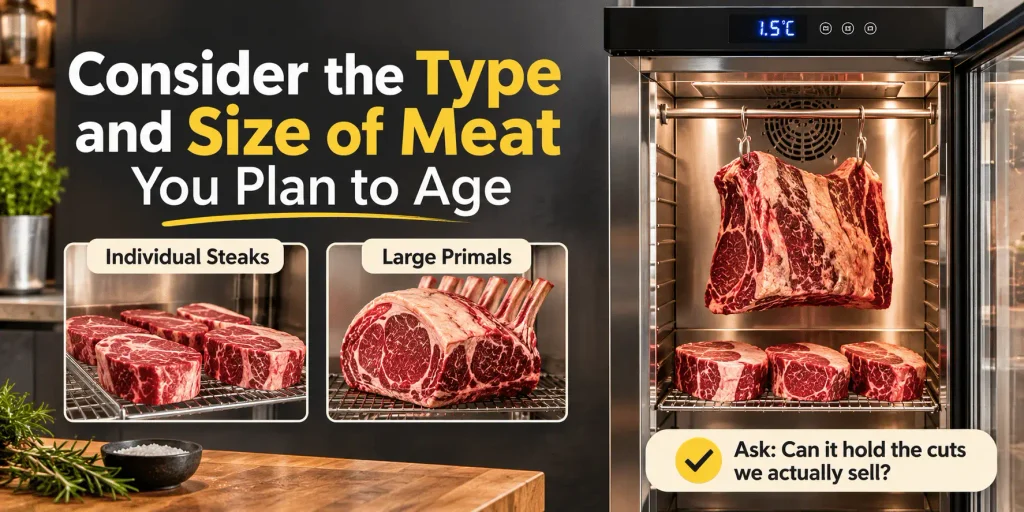
Consider the Type and Size of Meat You Plan to Age
Individual Steaks vs. Large Primals
In a compact cabinet smaller meat cuts are generally easier to arrange.
Meat parts like large rib sections, loins and bone-in cuts need more space. If these are common in your business, you should carefully see the shelf spacing and the available hanging arrangement before choosing.
Shelf Space vs. Hanging Space
Both of these storage methods affect how much meat you can fit in a dry aging cabinet.
Two butcher shops using the same cabinet may get different practical results. One may work mostly with smaller shelf-loaded cuts. The other may require space for larger hanging pieces.
So, it should not be asked that, “How many kilograms can a dry aging cabinet hold?” Instead what needs to be asked is “Can it hold the cuts we actually sell?”
Calculate Capacity Around the Aging Cycle
Aging Time Ties Up Cabinet Space
This is also one of the factors that can be missed when selecting the right dry aging cabinet capacity. As a normal process, the dry aged beef stays in the cabinet for weeks. It is not just a few hours.
Commercial dry aging practices commonly use aging periods of around 21–35 days. The right period of time depends on the product and validated operating conditions.
That means today’s batch may still be occupying the cabinet when next week’s orders arrive.
Consider Batches, Not Just Kilograms
You should plan for overlapping batches if you want to serve or have dry-aged beef every week.
Here are some things you need to workout.
· Try to work out how much meat you expect to sell.
· See how long each batch will age.
· Keep in view when you need to load the next batch.
· Leave some breathing room. A cabinet packed to its physical limit may not be the best cabinet for a smooth daily operation.
Which Capacity Fits Different Restaurant and Commercial Scenarios?
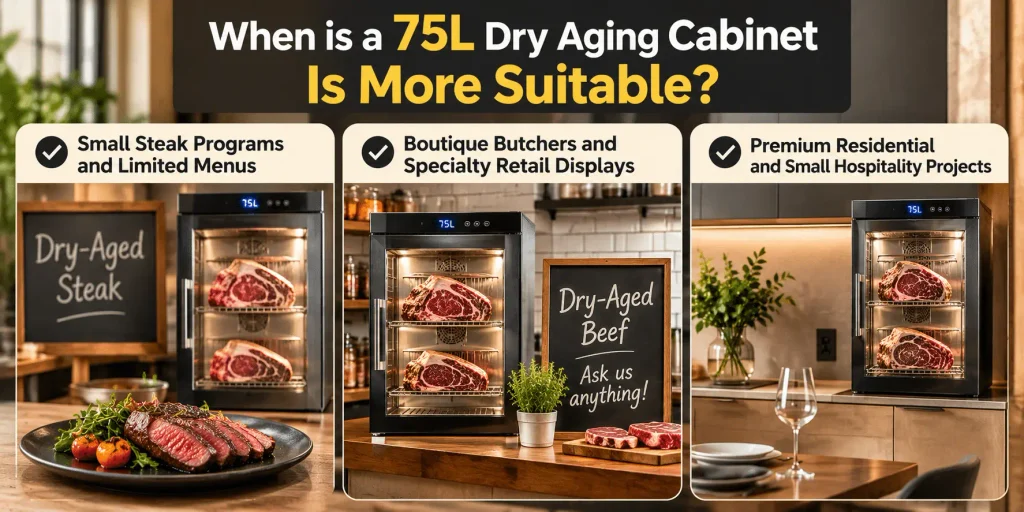
When is a 75L Dry Aging Cabinet Is More Suitable
- Small Steak Programs and Limited Menus
Some restaurants offer just one or two dry-aged options. In some places you maybe just testing customer demand before adding more premium cuts.
In such situations the 75L dry aging cabinet can be a good choice to start. It gives you dedicated aging space without taking up room for equipment you may not need yet.
- Boutique Butchers and Specialty Retail Displays
Smaller butcher shops often have limited floor space. A glass-door dry aging cabinet can also become part of the display.
Customers can see the beef aging. They can ask questions. They can learn what makes a dry-aged cut different. It can act as a useful equipment as well as a way to tell the story behind your products.
- Premium Residential and Small Hospitality Projects
A private dining room, small hotel kitchen or premium home kitchen may only need occasional batches.
A compact cabinet is suitable if aging volume is limited and floor space is tight. Buying a larger unit will be under utilized because it will rarely be full.
When a 125L Dry Aging Cabinet Is Better Option
- Restaurants With Regular Dry-Aged Beef Sales
If dry-aged beef is a regular menu item and sells well, you will need to manage more than one batch over time.
The SN-125 is the best choice for this. It provides additional internal space for arranging different cuts and managing overlapping batches. This can be helpful when customer demand is steady.
- Steakhouses, Butcher Shops and Specialty Food Programs
Steakhouses and specialty food businesses often work with several cuts and aging schedules.
The SN-125 offers more arrangement flexibility for these operations. SUNNAI also lists applications for certain cured meats, salami and other specialty foods.
Just remember that different products need suitable and validated processing conditions. One aging setup should not automatically be used for everything.
- Projects Expecting Future Volume Growth
Some times you plan to open a new steakhouse or expand a butcher shop. In such cases you must estimate where your business might be a year or two from now.
A larger cabinet may help you avoid outgrowing your equipment too quickly. But make sure to compare the extra purchase cost with the cost of adding a second smaller cabinet later.
Sometimes buying bigger dry aging cabinet is more wise. Sometimes starting small is the smarter business move. So, it depends on your requirements.
When Multiple Smaller Cabinets May Be Better Than One Larger Cabinet
- Separate Aging Programs
In some situations you may want to manage different aging durations or keep experimental batches separate.
In such cases, two smaller cabinets can make things easier. You can organize different products or batches without having everything in one chamber.
- Capacity Redundancy
Backup of your dry ager is also important.
If one large cabinet has a service issue or breaks down, all your aging inventory may be affected. When you have multiple smaller units it reduces dependency on one cabinet.
For businesses handling expensive meat, that extra flexibility is worth considering.
Installation Space Can Matter as Much as Dry Aging Capacity
Compare the Physical Footprint Before Selecting Capacity
Before ordering, measure the space where the cabinet will be installed. A model that looks compact online may be unfit once you take into account the ventilation and door access.
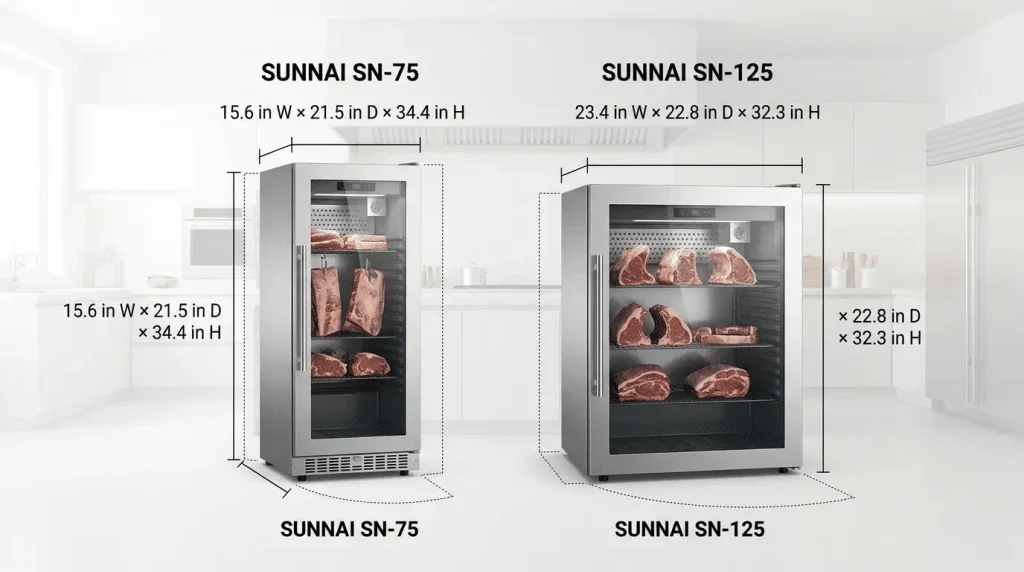
- SUNNAI SN-75 Footprint
The SN-75 measures approximately 21.5 inches deep × 15.6 inches wide × 34.4 inches high.
Its narrower width can make it easier to place in smaller kitchens, butcher shops and specialty retail spaces.
- SUNNAI SN-125 Footprint
The SN-125 measures approximately 22.8 inches deep × 23.4 inches wide × 32.3 inches high.
It needs more horizontal space, but offers greater internal volume and more flexibility for arranging cuts.
Freestanding vs. Built-In Installation Changes the Decision
- SN-75: Freestanding Configuration
The SN-75 has a freestanding installation design. It has rear ventilation.
You should not push it tightly against a wall. Do not hide it inside cabinetry without checking the manufacturer’s instructions.
It needs the specified ventilation space to operate as intended.
- SN-125: More Flexible Project Integration
The SN-125 supports both freestanding and built-in installation. It comes with bottom ventilation.
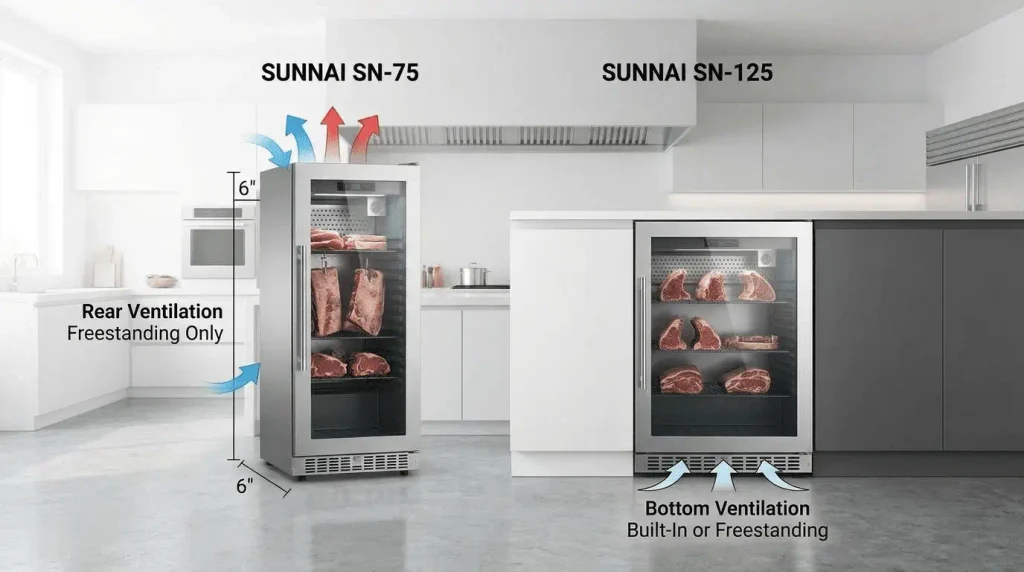
This can make it a better fit for custom commercial cabinetry, hotel kitchens and hospitality projects. Here the equipment needs to sit neatly within the overall design.
Plan for Workflow and Not Just Available Floor Space
- Kitchen and Prep-Area Placement
The staff access during a busy shift should be considered. Try to look out for these factors.
· Can they open the door without blocking a walkway?
· Is there room to carry a large cut in and out?
· Will the cabinet get in the way of food preparation?
These details can make everyday work easier or more frustrating.
- Front-of-House Display
A dry aging cabinet does not has to stay hidden in the back. In a premium steakhouse you can make it visible. Showcasing the aging beef can become part of the dining experience. Customers can see the product. They will understand why dry-aged steaks are a special menu item.
Just make sure the location works for staff access. It should also follow the cabinet’s installation requirements.
Choosing a SUNNAI Dry Aging Cabinet for Commercial Projects
Compare SN-75 and SN-125 by Application and Not Capacity Alone
- Shared Dry Aging Fundamentals
Both SUNNAI models include:
· Temperature adjustment from 2–14°C.
· Humidity settings from 50%–85%.
· Compressor and fan cooling.
· Three stainless-steel shelves.
· Carbon filtration.
· Triple-layer glass.
· 304 stainless-steel interiors.
These features support a controlled cabinet environment and practical day-to-day use.
SN-75 for Compact Commercial Applications
With 75L of capacity and a meat load of 20–23 kg, the SN-75 is suited to smaller restaurants, specialty retailers, and businesses starting a dedicated dry-aging program.
Its narrow footprint is especially useful when floor space is limited.
SN-125 for Higher-Capacity and Integrated Projects
The SN-125 offers 125L of capacity and a published meat load of 20–30 kg.
Its wider interior gives operators more room to arrange different cuts. Built-in compatibility and bottom ventilation also offer more flexibility for commercial project designs.
B2B Buyers Should Look Beyond the Individual Cabinet
For distributors, hospitality suppliers and appliance brands, the product itself is only part of the decision. You may need a different internal configuration or control systems to meet your market’s requirements.
순나이 offers OEM customization options for internal layouts, controls and branding. You can discuss these needs before hand if you are planning a larger order or a multi-location project.
Conclusion: Choose Dry Aging Capacity Around Your Business, Not Just Cabinet Liters
So, which dry aging cabinet size is more suitable for you as a buyer or business owner?
You should select the 75L SN-75 if:
· Space is limited
· Your aging volume is moderate
· You are starting a smaller program.
You should buy the 125L SN-125 if:
· You need more room for different cuts
· There are overlapping batches
· You have regular turnover
· You require built-in installation.
But remember the dry aging cabinet capacity should not be decided on liters alone. You should look at actual meat load, cut sizes, shelf arrangement, airflow, installation space and future demand together.
For a restaurant owner, distributor, butcher or project buyer the process should be started by deciding what your operation really needs. Then speak with SUNNAI about the right cabinet and configuration for your project.
자주 묻는 질문
Should I choose one 125L dry aging cabinet or two smaller cabinets?
One 125L cabinet gives you more internal space in a single unit. Two smaller cabinets may be better if you need to separate aging schedules, products or experimental batches. They can also reduce dependence on one chamber.
How much space should I leave around a dry aging cabinet?
It depends on the model. The SN-75 has rear ventilation. The SN-125 has bottom ventilation. Follow the manufacturer’s installation instructions. Do not use a general clearance figure.
Can a dry aging cabinet be built into commercial cabinetry?
The SN-125 supports built-in installation. The SN-75 is listed as freestanding. For the SN-125, you should confirm the required opening dimensions. Check the ventilation and service access before building the cabinetry.
Does a larger dry aging cabinet age meat faster or better?
No. A larger cabinet does not make meat age faster. Nor does it make it taste better. The aging process depends on controlled temperature. It depends on humidity, airflow, time and proper handling. Cabinet size mainly affects how much space you have to organize your batches.
What should restaurants consider besides capacity when buying a dry aging cabinet?
Look at the cuts you plan to age. See the shelf arrangement, temperature and humidity controls. You should also consider ventilation, installation space, cleaning access, certifications and expected demand. Also consider how long each batch will occupy the cabinet.