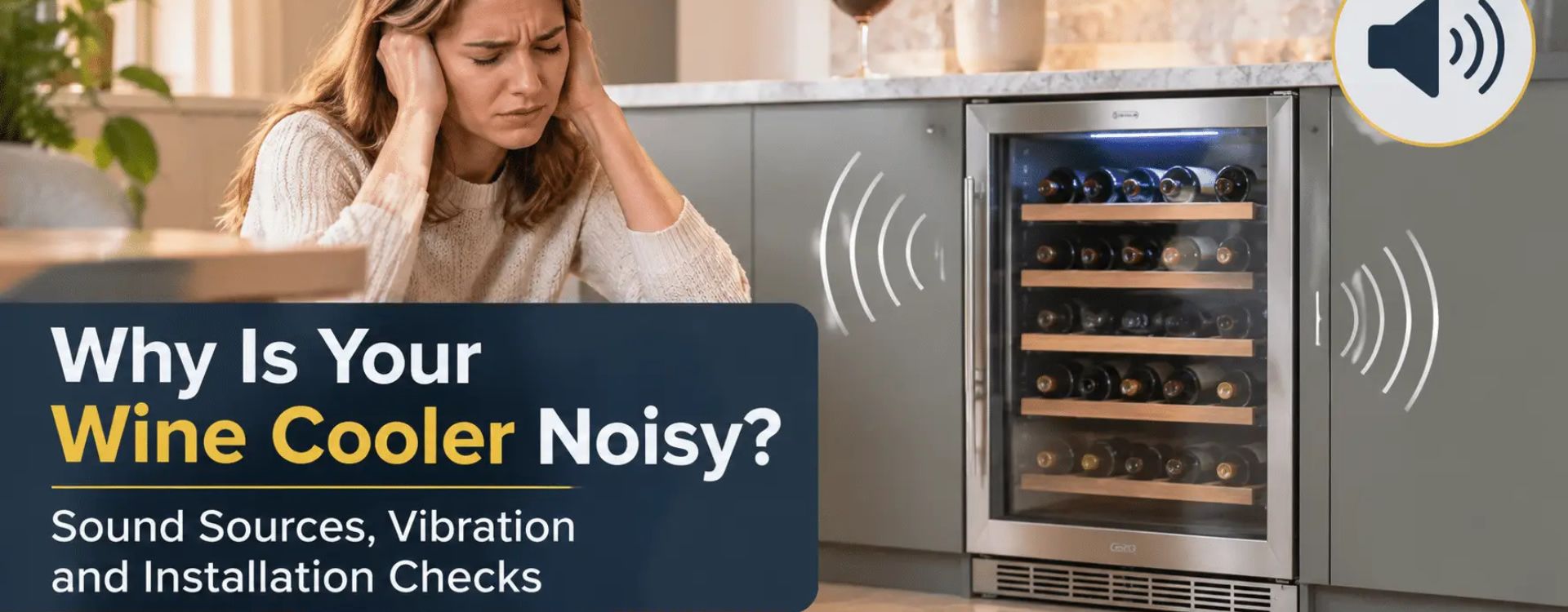
Think about this situation. You are sitting in your open-plan kitchen. Enjoying a quiet evening. The conversation pauses for a moment. And suddenly you hear a sound. A low humming sound coming from the wine cooler. You stop and think, “Why is my wine cooler noisy?”
Is it supposed to sound like that? Has something come loose? What are its sound sources, vibrations and should you be worried?
Well, we know that a ワインクーラー does make some operating noise. However, these are just normal. This does not mean that new and unusual rattles or louder hums should be ignored totally.
You need to understand what you are hearing and when it happens. Sometimes the sound comes from normal cooling operation. In other cases, the appliance may be touching a cabinet. It may be vibrating because it is placed unevenly. Or there may be poor ventilation.
To make things more understandable, let us look at some common causes of wine cooler noise. See how to make a few installation checks on your own and what to consider when choosing a wine cooler for a noise-sensitive kitchen or hospitality project.
Understand the Sound Before Assuming There Is a Fault
Before supposing something is wrong, you need to listen to the type of sound that the cooler is making. A compressor hum is different from a loose shelf rattling. A brief click is different from repeated banging. So, let us see some normal sounds made by wine coolers.
Compressor Hum and Fan Airflow
Most compressor wine coolers produce a low humming sound. This happens while cooling. The compressor circulates refrigerant through the cooling system. The fans help move air where needed.
You may notice the sound more at certain times like the following:
- When the cooler first starts cooling.
- After you load several warm bottles.
- Following frequent door openings.
- When the appliance is working to recover its set temperature.
The sound can change as the cooling demand changes. A fan may also produce a soft whirring or airflow noise.Now, here’s something that you need to check. Is the sound coming from the appliance itself? Or is it something that is vibrating around it?
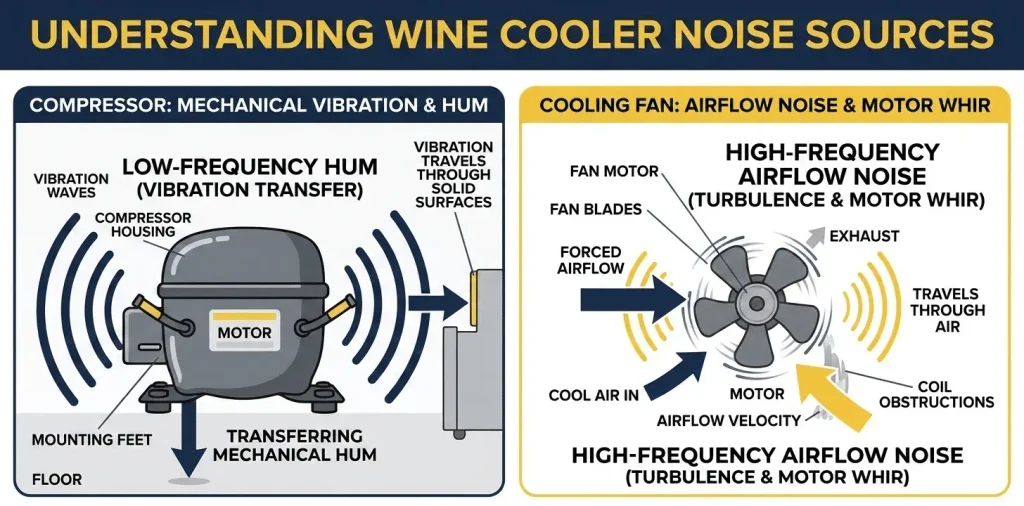
These are not quite the same problem. Operating noise travels through the air. Vibration can transfer into the floor. It can go to the cabinet or nearby furniture as well. A mild hum may become much more noticeable when the appliance is in contact with a hard surface.
Clicking, Bubbling Or Gurgling – Liquid Like Sounds
A wine cooler may also make occasional sounds that seem a little unusual.
ここではいくつかの例は、次のとおりです。
- クリック: This may happen when the cooling system switches on or off.
- Gurgling or bubbling: These types of sounds may come from refrigerant moving through the cooling pipes.
- シューという音: It may occur as refrigerant circulates through the system.
- Brief popping sounds: This noise can be associated with materials expanding or contracting as temperatures change.
These sounds are part of normal operation. However, do not automatically assume every click or gurgle is harmless.
You must be vigilant and pay attention to the pattern.
Does it happen briefly during a cooling cycle?
Has it always sounded this way?
Or has it suddenly become louder and more frequent?
A new sound that is persistent should be checked closely.
Changes in Sound Matter More Than a Sound Label Alone
A louder hum on its own does not tell you exactly what has gone wrong. But certain changes are worth investigating.
Things that you should be watchful for include the following:
- Repeated loud clicking or unsuccessful starts.
- Persistent rattling that doesn’t stop after checking loose items.
- New grinding, scraping or banging sounds.
- Noise that becomes progressively louder.
- Unusual sounds accompanied by poor cooling.
You should not try to diagnose internal components just by listening. Try to record a short video of the sound. Then note when it occurs. This gives the service team useful information about the problem.
Check Installation and Room Layout Before Replacing the Appliance
Could installation be making your wine cooler louder?
Absolutely. This happens a lot. Before you think about replacing the appliance, make sure to check how it has been installed.
A cooler can be working normally. However, it may sound louder because it is not properly supported. Sometimes it has contact with surrounding furniture.
Check Leveling and Contact Points
You can start with the floor or cabinet base.
Is the appliance stable?
Does it rock slightly when touched?
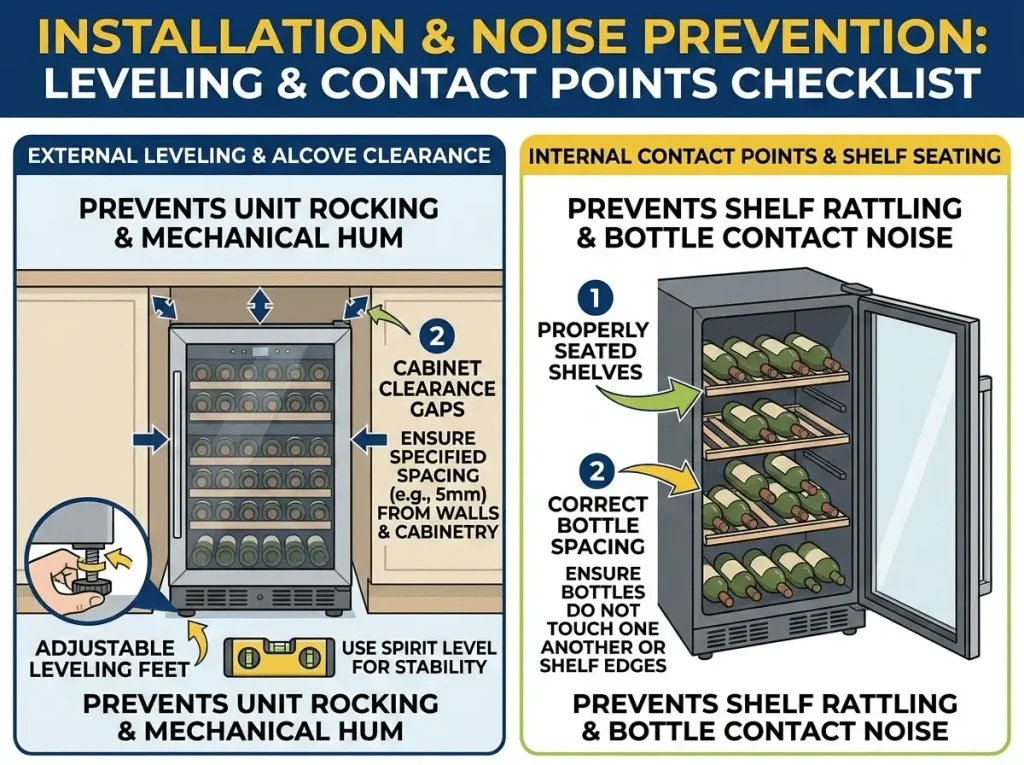
A wine cooler should be supported and leveled as per the installation instructions provided. If its feet are not properly supported even the normal operating vibration may become a noticeable rattle.
Next, you should look around the appliance. See for the following things:
- Is its body touching a nearby cabinet?
- Is the door or frame rubbing against surrounding trim?
- Is something resting on top of the cooler?
- Are the shelves seated correctly?
- Are bottles touching one another or vibrating against a shelf?
Sometimes these small things are easily overlooked. For example, you may have two bottles placed too close together. This may be producing a light rattling sound when the compressor runs.
So, you should check the shelves and bottle positions. Do not immediately assume that the noise is coming from the compressor.
Avoid removing the required fixings. Do not make adjustments that are not permitted by the manufacturer.
Can Poor Ventilation Make the Wine Cooler Run More Often?
Yes, it can. It can impact the operating conditions.
A compressor wine cooler needs to release the heat removed from its interior. If the required ventilation path is blocked, the heat ejection may become less effective.
With high surrounding temperatures there will be increase in the cooling demand.
The result may be longer or more frequent operating periods. This will make the compressor and fan sounds more prominent.
This is more common in built-in wine coolers. A unit may fit neatly into a cabinet opening. But the surrounding cabinetry must still allow the ventilation arrangement specified for that model.
The required ventilation gap for a wine cooler should not be just guessed. Always check the installation manual for the exact model requirements. A clearance recommended for one model may not be suitable for another.
Evaluate Noise Where People Actually Sit, Talk and Sleep
This is something that often surprises people. The same wine cooler can be quiet in one location and disturbing in another.
Hence, you should think about where it will be installed.
Open Plan Kitchens
A wine cooler installed beside a kitchen island may be best suited. It remains close to where people sit, eat and talk. If the dining table or lounge is nearby, its operating sound may become obvious during quiet periods.
So, do not assess the appliance only while standing beside it. Listen to it from the places where people will actually spend time.
レストランやバー
A busy restaurant has background conversation. There is music and even noise from kitchen activity.
During service, a wine cooler’s operating sound may go unnoticed. But what happens during a quiet afternoon or after closing?
If the cooler is near a dining table or private seating area, then you need to evaluate it during quieter conditions too. Busy-hour noise can hide sounds. But later customers may notice them.
Hotel Rooms and Guest Areas
A wine cooler in a hotel guest room has a different purpose as compared to one installed in a restaurant wine display.
Guests may expect a quieter environment here. Especially during nights. A sound may seem acceptable in a lounge. But it may become very disturbing if it is beside a bed.
For this reason, you should judge the cooler as per the room it will be used in. Before selecting a model to buy, check the listening position. Do not just buy a product because it is labelled quiet. It can still make some sound and noise.
How Should You Read Wine Cooler Noise Ratings?
A decibel figure is often encountered when someone is comparing wine coolers. Do you know how you should read wine cooler nose ratings?
First, you need to see what has been measured.
Sound Power and Sound Pressure Are Not The Same
Both of these are different. You need to know the difference to understand the product specifications.
- 音響パワー describes the acoustic energy that an object emits. It is a characteristic of the sound source under some stated conditions.
- 音圧 describes the sound level at a location. It can change with distance. It vary with room size, reflections and the position of the microphone.
In simple terms, sound power tells you more about the source of sound. Sound pressure is something that describe what is measured at the listener’s position.
Both can be expressed in decibels. However they cannot be interchanged. So, if one supplier publishes sound power and another gives sound pressure, if you compare the numbers directly it can be misleading.
When reviewing a wine cooler specification, you can ask the following questions:
- Is the rating sound power or sound pressure for the wine cooler?
- どのような試験方法が用いられましたか?
- Under what operating conditions was it measured?
- Which exact model and configuration does it cover?
- If sound pressure is reported, where was the microphone placed?
If you are buying wine cooler for a project there will be an agreed noise requirement. Based on this, you should request the supporting acoustic documentation from the manufacturer for conformation. Do not rely on a number that is shown in a product description only. For supplier engineering context, review SUNNAI’s approach to noise and vibration control.
Why the Sound Character Is Important Too?
Two coolers may have similar numerical ratings. But they may not sound identical.
One may produce a steady low hum. The other may have intermittent clicks. They might have a more noticeable airflow sound.
You should also see how often the appliance operates and makes the sound. A sound that occurs briefly is different from one that continues through most of the evening.
For noise sensitive projects, compare actual samples under similar conditions. You should use the same settings. Load similar bottles. Compare the same installation arrangements.
Listen through a representative operating cycle. This should include the temperature recovery after normal use.
A phone recording can help document a change or an unusual noise. However, it is not a substitute for suitable acoustic measurement when a project requires formal verification.
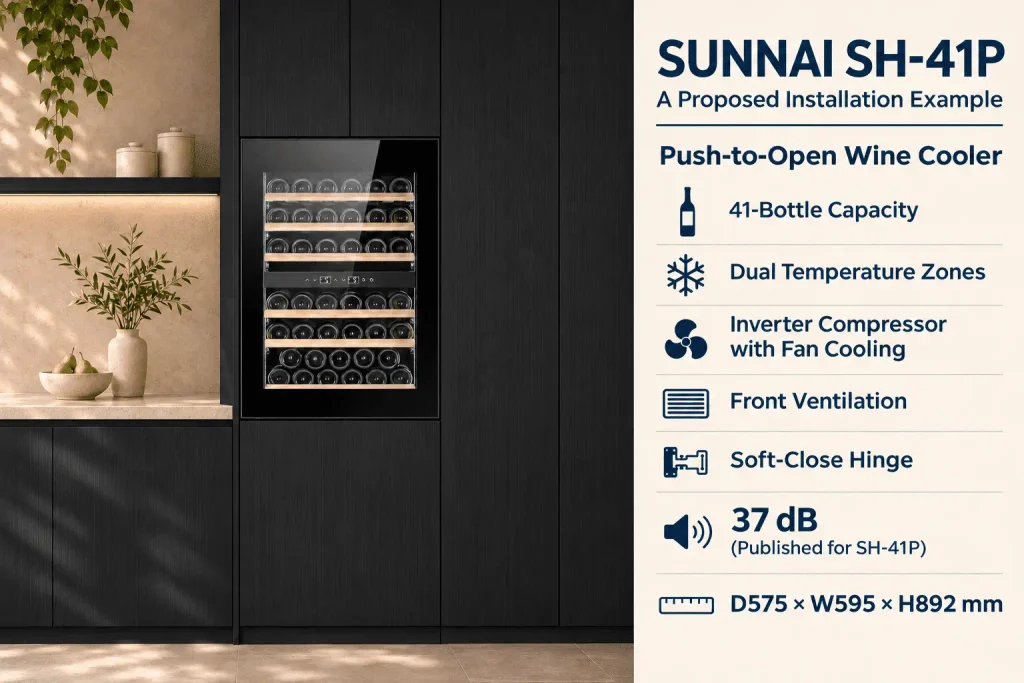
SUNNAI SH-41P: A Proposed Installation Example
Let’s consider an example. A kitchen brand is planning a built-in wine cooler. It will be installed in an open-plan residential kitchen.
その SUNNAI SH-41P is one model the team could evaluate. Its published specifications include:
- Built-in, push-to-open design.
- 41-bottle capacity and 112L gross volume.
- Dual temperature zones.
- Inverter compressor with fan cooling.
- Front ventilation.
- Soft closing hinge.
- Published noise figure of 37 dB.
That 37 dB figure belongs specifically to the SH-41P product listing.
You should confirm the measurement basis and test conditions with スンナイ. Do this before making direct comparisons or including the figure in a contractual specification.
Now, imagine the SH-41P has been installed under a kitchen counter. The homeowner notices a rattling sound.
What should the project team check first?
- Is the appliance stable and correctly leveled?
- Is its body touching the surrounding cabinet?
- Are the shelves seated properly?
- Are bottles making contact with one another?
- Is the front ventilation path unobstructed?
These are practical installation checks. They are not a diagnosis of the wine cooler’s internal components. The objective should be to sift out avoidable vibration. Rule out the installation issues if any. You need to do this before requesting technical support.
For kitchen brands and hospitality buyers, this is a useful way to evaluate the model. You should first consider its published specifications. Then review the installation documents. Make sure to test the actual operating experience in a representative setting.
Make Quiet Operation Part of Your Purchasing Requirements
If you are buying the wine coolers for a kitchen range, hotel or even a restaurant, the acoustic expectations should not be left unaddressed. Keep them in view until the installation is complete.
They should be incorporated in the project brief. For example, specify the intended location where the wine cooler will be installed. Like an open-plan kitchen. It could be a guest room or a restaurant wine display.
Then request the exact model configuration from the manufacturer. You should find out the acoustic documentation and approved installation arrangement.
If possible, assess a physical sample under realistic conditions. You can keep the settings, loading and installation consistent. Then compare your options.
Also it should be agreed upon before hand that if the installed appliance produces an unexpected sound what will be done.
You should record the model number, room conditions, sound observations and any symptoms affecting cooling performance.
This gives the supplier or service team a much clearer starting point than a general complaint that the wine cooler is noisy.
A quick installation and noise handover checklist
Before signing off the project, check:
メカニカル
- Stable support and correct leveling.
- Shelves properly seated.
- Bottles not rattling against one another.
- No unintended contact with cabinets or nearby surfaces.
オペレーティング
- Required ventilation path is clear.
- Settings are appropriate.
- Sound is observed after the temperature has stabilized.
引き渡し
- Model and configuration recorded.
- Room and installation conditions documented.
- Any unusual sounds recorded.
- Unresolved issues referred to the appropriate support team.
結論
If your wine cooler is sounding noisy, it does not mean that there is a fault. Sometimes the sounds you are hearing can just be normal compressor or fan operation noise. There are also instances where the problem may be a loose shelf, bottle contact, poor leveling or restricted ventilation.
So, one should not rush to replace the wine cooler immediately. Instead you should first, understand the sound. Check the installation. Look at the operating conditions. Then decide or get it diagnosed by an expert.
For kitchen brands and hospitality buyers, the best approach is to compare documented acoustic specifications. You should assess the actual appliance in its intended setting.
A little planning and efforts before installation can help avoid a lot of frustration after handover.
よくあるご質問
1. Why does my wine fridge make clicking or gurgling noises?
All wine coolers has occasional clicks. These may occur when the cooling system switches on or off. Gurgling can also come. They happen when refrigerant circulates through the pipes. You can check whether the sounds are brief. See if they are consistent with normal operation. Any unusual, new or repeated noises should be evaluated for issues.
2. Why is my wine fridge louder at night?
The wine cooler is not actually louder at night. It happens due to surrounding environment. During the day, there is conversation, music and other household sounds. They can mask its operation noise. At night, the background becomes quieter. This makes the compressor or fan more obvious.
3. Are built-in wine coolers quieter than freestanding models?
Not actually. Noise depends on the model. It varies as per the cooling system, installation and surrounding environment. A poorly supported built-in unit may transfer vibration into cabinetry. A freestanding model may feel quieter in a particular room than another. They should be compared with exact models and installation requirements.
4. How should hotels and restaurants evaluate wine cooler noise?
They should evaluate the wine cooler in the location it is intended to be installed. See it during quiet operating periods. You should have look at the nearby tables, guest rooms and listening positions. The acoustic documentation should also be requested from the manufacturer. Test a representative sample under consistent operating conditions.
5. When does wine fridge noise require professional service?
If you hear a sound from your wine cooler that is new, repetitive and gets progressively louder then you should seek professional support. If there are problems with cooling and you observe that there are repeated unsuccessful starts, grinding or scraping then call an expert. Record the sound and operating conditions. Do not try to repair internal parts yourself.